Cinemanila 2005 has come and gone. I've watched quite a lot of new, great movies and I hope to do the same next year.
Well, just a few closing thoughts:
1) I thought the price reduction was great (it inspsired me to watch as much as three a day,) but I was a bit saddened that not a lot of people went to see it. Only a few people went to the screenings (the most being Ilusyon and Ala Verde Ala Pobre) and I was dismayed to see only a few people appreciating cinema of this quality and caliber.
2) Perhaps some segments of the festival could be made more audience friendly. Perhaps crowd pleasers would rake in more people.
3) There sure were a lot of gay men watching Masahista...
4) My pick of the festival, as far as the digital competition was concerned, was Ala Verde, Ala Pobre. When I saw the winner was Tuli, I wondered why - it really wasn't all that great.
5) I'm glad Korean cinema is being given attention this year. I was glad The President's Last Bang won an award.
6) My biggest regret was that I never got to see the films I really, really, really wanted to see. There were three: Pen-ek Rataranuang's Last Life in the Universe, The President's Last Bang, and Better Luck Tomorrow.
7) I'm glad, however, from the films and talent that I saw, that Philippine cinema has a bit of promise for the future. Good luck to all the filmmakers making films out there independently, following their dream and creative calling. Rest assured I'll always be there to watch them (or, at least, want to watch them.)
Wednesday, October 26, 2005
Tuesday, October 25, 2005
Cinemanila Diaries 4: Masahista

Okay, we're wrapping up now, and here's the last new film I saw at Cinemanila 2005:
Masahista (2005)
Brillante Mendoza's independent film Masahista caught my attention when it won a prize the Locarno International Film Festival, tying with another movie. Once I saw that it was screening at a nearby theater I went over to watch it.
The film might look like a gay film, but it isn't. The film might look like it consists of one raunchy scene after another, but it really doesn't. These facts turn out to be the greatest asset of the movie - we'll come back to this later.
The story of Masahista is shown to us in a fractured manner: Coco Martin plays Iliac, the titular 'masahista' of the title, giving massages and a 'little extra' to their clients. When Iliac learns that his father is very sick, he comes home to Pampanga, only to learn that he is too late. The movie cuts back and forth between the night before Iliac leaves as he serves his last and only client of the night and the days after his arrival at Pampanga where he copes with his father's death and prepares for his burial.
The movie is bilingual (trilingual if you count English) between Kapampangan and Tagalog, the first time I've seen another Filipino dialect in a movie since Panaghoy sa Suba. The film is quite well made, and I have no problems with anything regarding its production.
Okay, let's get back to that part I'd say I'd go back to. This film's strongest point is that it doesn't glorify or romanticize the sex going on in this movie. Instead, it portrays the act as something that takes something away from Iliac and his fellow Masahistas. One of the most striking set pieces in the film is the scene where scenes from a funeral are juxtaposed with scenes with the Masahistas doing their job. It kind of implies that this exacts some kind of death of the spirit in these young men.
This film is a very introspective character piece that surprised me quite a bit. Although it's not as good or thorough in portraying the main characters past and inner turmoil as, say, This Charming Girl, it still serves up a good dish of drama and social commentary. It's a great way to end my run.
Sunday, October 23, 2005
Cinemanila Diaries 3: Together, Dilim

More Cinemanila goodness. This time it's a bit of football and darkness for all.
Together (Lukas Moodysson, 2000)
Let's begin with the reviews. Together comes from Lukas Moodysson, director of such films as Fucking Amal and the recent A Hole in My Heart. Thematically, this movie follows the mood of the Moodysson's earlier films - light, warm dramas with focus on character development. Set in Stockholm in 1975, the film is about how a housewife, Elisabeth ends up living with her two kids in a commune headed by her saintly brother after getting into a fight with her husband. Of course, each character has their own problems to deal with: Goran, the saintly brother, basically lets his partner get away with sleeping with another man in what they call an open relationship; Rolf, Elisabeth's husband, faces the prospect of losing his family, Elisabeth gets used to the situation of living in new, awkward surroundings and explores her life; Lasse, one of the member's of the commune, is concerned with his wife's newfound homosexuality; Klas, himself a homosexual, tries to let Lasse liberate himself, Eva, Elisabeth's daughter, befriends the son of a couple across the street who are critical of the commune; and the kid, whose name I can't remember, tries to make some friends.
The movie seems to tell us something about society and a bit on how we some of us are so politically idealistic. I look at the news and I see people trying to make a change in the way we live with these 'perfect' societal systems. The thing is, these things are made assuming people are not corrupt and totally unselfish. As we see the film unfold, the tightly-ordered commune lets go of its rules and gives in to a little capitalism. There is compromise. Also, one of the more telling segments of the film is when the zealous politically-inclined man tries to talk to Eva about the wonders of his political system. Eva doesn't care; she just wants to do something else. Much like most of us: we're all talking abut how this can change our society and how revolution is important, but the thing is, most of us just want to live our lives.
The look and feel of the film, from the editing, the art direction, the fade-outs and even the title credits, makes the movie feel like a film from the time period in which it had taken place.
The movie ends with football and a warm and fuzzy feeling - the game a fitting symbol for the change the characters went through in the movie, towards a hopeful ending.
Dilim (2005)
At first, I was expecting Dilim to be a serious drama of some sort. As I found out, the film turns out to be a superhero movie. The director of Dilim, Topel Lee, is a well-known music video director - and it shows. Dilim is a movie that visually fits it's title: not only does it take advantage of the darker pictre DV gives, it is almost completely bereft of color - with most coloers in dark violet or shades of gray.
As befiitting a superhero movie, Dilim has all the cliches - the troubled anti-hero protagonist, the straight cop who witnesses the effects of the hero's antics, the leading lady, the evil-as-hell villain. Dilim does not innovate on these stereotypes; the film aims more to present a visually interesting story.
The action scenes are edited with varying quality - the action sometimes seems choppy or perfectly fluid. The action is also heavily borrowed from films like the Matrix, and with sub-par computer graphics (understandable considering the drastically low budget) the effects do nothing but to give the action an amateur feel. Nice ambition, limited means.
The acting is theatrical - which would be fine in a theater, but would otherwise feel hammy, overacted and plain weird in a medium such as film, which is what happened here. I feel this is one of the weaknesses of our local actors: they are excellent in theater but the acting doesn't translate as well as it should into a medium like film.
Dilim wraps up its story in a clean, nice manner - but it leaves this viewer partly unsatisfied. At least I can say it was a nice try.
Sunday, October 16, 2005
Cinemanila Diaries 2: The King, Tuli, Ala Verde Ala Pobre
 Day 2 of my Cinemanila exploits: M1 Garands, Circumcision, and railroad tracks.
Oh, and I think I'm going to use the word dichotomy. Watch out for it. Be warned, spoilers abound!
The King (2005)
This feature film starts with a young man, Elvis (Gael Garcia Bernal, in one of his few English-speaking roles) who, after leaving the Navy, seeks out his biological father. His father, David Sandow (William Hurt), has now become a preacher in conservative Southern America, and has a family now, with a son and a daughter. Soon Elvis begins to interfere with the family's affairs, actions that increase in intensity and destroy the Sandow family dynamic until the film's nihilistic finale.
Early on we see the dichotomy between Elvis' life and the life of his half-brother Paul: Elvis with his old car and seedy apartment, with no future in sight, and Paul with his comfy room, brand new SUV and bright future. The latter half of the film sees events go into a downward spiral as Elvis usurps Paul's place in the Sandow family in true biblical fashion; throughout the film I thought of the number of comparisons this movie had to some biblical stories. However, although we see the implications of Elvis' destructive actions, we never see what motivates him to do these things. Is it left ambiguous? Or is it an allusion to it being the will of a Higher Being, a test?
Bernal portrays Elvis ambiguously; an enigma that is never explained. Kind of like an semi-antithesis to the titular character of Takashi Miike's Visitor Q: where the visitor in that movie would passively influence the family to its eventual relative benefit, Elvis directly influences his family to its eventual destruction.
By the way, he speaks English perfectly, with no trace of Spanish accent whatsoever, something that surprised me quite a bit.
The King is a hard movie to get through. It is disturbing and quite unsettling as things come towards the inevitable climax. Whether it is effective in delivering whatever message it was intended to convey, I leave to you.
Tuli (2005)
Aureus Solito may be a familiar name to some Philippine Cinephiles; he was responsible for the indie film Ang Pagdadalaga ni Maximo Oliveros. His entry to the digital film competition, Tuli, is also a coming of age film; and it sorta involves circumcision (Tuli is a verb that means to circumcise in Filipino.)
Daisy (Desiree del Valle) is a girl who lives in a quiet, sylvan barrio, whose isolated locale promotes the impression of a world closed to everything else around them (and perhaps, modernity?) The people there possess traditional beliefs and are deeply religious (in fact part of the movie takes place during holy week.) After a lot of bad juju with the barrio's male population, she swears never to fall victim to the wiles of a man again. In short? She becomes a lesbian.
This does not make the residents very happy, and Daisy and her lover, also betrayed by men, must stick together and persevere.
The main problem is that the above doesn't really happen until the last third of the film - more than half of the film is reserved for exposition, which bogs down the film a lot. It also made the film quite hard to understand for the casual viewer - until things get into gear. It's the awkward pacing that turned me off from this film a bit.
No complaints about music of visuals - visually the cinematographer takes advantage of the naturally dark look of DV and exploits light to make the impression of a barrio that is isolated from the rest of the world, shrouded in strange, hazy, almost supernatural, forces.
Desiree del Valle does a decent job as Daisy, although the angst in her character does project a little too powerfully for my taste. The rest of the actors involved also do a decent job and don't enter the 'theatrical' category.
This film, despite what I see is its obvious faults, is nevertheless an interesting exploration of sexual discovery. I look forward to seeing more of this in the future.
Ala Verde Ala Pobre (2005)
Briccio Santos is a name I haven't heard of before, but when I asked my mother, she knew he had made films before. Upon looking at the paper describing the movie outside the theater, I found that he has been out of the limelight for a long time.
If you want a short review, here it is: out of the eight films participating in the digital cinema category, this is my favorite.
Here's the long review: Ana Capri is Jessica, a former Japan entertainer who lives with his ex-NPA husband (Ebong Joson.) Together they live in the houses built beside the railroad tracks somewhere in Manila, and try to survive.
The opening sequence is kinetic, and at once we see the first thing I like about this film - it's bright, unlike all the other entries I saw. Somehow Santos' cinematographer has circumvented the effect of having a darker picture naturally shown in DV and given us a light-infused vision of the houses by the train tracks. Even darker scenes are given light, perhaps by effects and clever lighting. This is an irony, because the film and the themes it deals with are very dark. There are no corny comedic moments like we see in other films. The world our two protagonists live in is a world anyone would get out of. The thing is they have no choice, and they have to live with their wits and skill to survive. More often than not, however, they find that the world outside their own may not be as good as they thought, and more often than not they find the elements of society exploiting them.
The music is pounding, sometimes darkly elegant and apropos - as simple as it may be. There are some short noticeable moments of silence, and they complement the film's tone as well.
The fact that Ana Capri and Ebong Joson can pull off great acting performances (in many levels - I won't spoil it for you) is one of the high points of the film. Their acting is more or less natural, non-theatrical (a pitfall for most productions) and is a refreshing departure from what I've seen these days.
That's all I can say about that. Well, next time, more Cinemanila goodness, plus a little bit of something else. Watch out for it...
Thursday, October 13, 2005
Cinemanila Diaries 1: Cut, Ilusyon
 October 12-25 is time for the Cinemanila Film Festival, and in this time, movies from around the world will be shown in selected Manila cinemas. Imagine my unmitigated excitement upon hearing this news.
Unfortunately, I was unable to watch the opening film of the festival, Yoji Yamada's The Hidden Blade. A shame, since I found Yamada's earlier film (and first in a trilogy of films in which The Hidden Blade is the second) one of the best in that year.
Today I'm going to tell you something about what I think of two digital Filipino films being screened in the festival. Both are connected by one more thing: Jon Red, brother of acclaimed filmmaker Raymond Red, is involved with both.
Cut
Firstly, we have "Cut," directed by Red and starring Joel Torre. The film is about how a film editor (Torre) slips in and out of reality while he makes a feature film - his great opus, perhaps his last. Of course, I only got the bare essentials of that summary from watching the film itself - the rest was from a description of the film posted outside. I knew there was a film editor, and he was making a film of some sort - quite a testament to how the film itself translates onto viewer interpretation - which, in this case, falls into the category of 'kinda confusing.' Interestingly there is an undercurrent of humor that pervades the film and I am not sure if it improves the film or not.
It's also evident that the film is highly experimental - not only is the narrative non-linear, the entire movie has no spoken dialogue whatsoever. Now to me, this would be no problem, but for me to like it, the remaining power of the film would have to come from excellent sound and visuals.
Let's tackle the visuals first. Cut definitely has an eye for camera angles and composition - the digital medium is exploited here to good effect. Camera angles abound that remind me of Hideaki Anno's Love & Pop (1998) that get scenes at odd angles. As for editing, the style is fast, with lots of quick cuts - which probably has an (unintended?) use of preventing the audience from getting bored to death.
There is one thing about the visuals that I don't particularly like - the way the camera is handled. There is an overabundance of sudden zoom ins and zoom outs that it gets rather irritating. My opinion on the use of zoom is this: if possible, avoid. Manually move the camera closer instead. If you do want to use zoom, don't use it often. If you do it slow, you risk making the movement and flow look artificial. If you use it too fast, it becomes a music video-like feel. Once or twice is okay. More than 40 times and it turns into a cheap gimmick. At times the camera moves so much I was forced to look away to prevent myself from feeling uneasy. (It's nothing like the vomit-inducing Irreversible, but that film is in a class all into itself.)
Ironically, the few static, lingering shots in the film are those that I find the best.
Another disappointment is the sound - the synthesizer score is repetitive and really, really loud at times with the strings. I would have found the movie far better if there was no synthesizer score at all and replaced it with ambient sounds instead.
In any case, it's impossible to recommend or rate such an experimental film, but I can say that I was a bit disappointed with Cut. Approach only if you're into Jon Red or experimental film.
Ilusyon
The second film is Ilusyon, starring Yul Servo and Jaycee Parker. The film is a very strange concoction; it is partly written by Red and is directed by Paolo Villaluna and Ellen Ramos.
The film is set in 1958 and starts as a surreal comedy; Miguel (Yul Servo) is an aspiring painter who moves to his father's small apartment in Manila to follow in his father's footsteps. He arrives only to find out that his father has fled in order to do a little bit of soul searching. With no talent whatsoever in painting art, he is relegated to painting houses. One day a mysterious beauty named Stella (Jaycee Parker) enters his life and he immediately falls in love with her. As he lives a lie with Stella, he gets deeper and deeper into a hole he may not get out of.
The second half of the film is more dramatic and deals with the repercussions of Miguel's love affair. It becomes evident as the film goes on that Miguel is living a reflection of the life of his father, culminating in the final scenes of the movie.
The surreal tone of the movie is a refreshing departure from normal Philippine cinema; however some scenes intended for comedic effect turn ridiculously corny thanks to ill-placed dialogue.
Visually the film is excellent; most of the scenes have a murky, dreamy feel - one of the advantages of DV is how you can use light to create that effect. It's wonderful how a static camera can capture a scene in such nuanced ways, and with DV you can fit those cameras into tighter, more exotic spaces. Composition wise the film is excellent, with imaginative uses of color and space.
There are two scenes in the movie that I find jarring - they are transition scenes that show our protagonist/s walking around a montage of black and white locales from the 50's. It was done in Pinoy Blonde and it was okay there, but it feels out of place here. It's the transition from filmed DV and processed scenes like this that probably did it.
The music is an excellent mix of old songs of the time to piano music that sets the mood beautifully. There isn't really much else to say except that I haven't seen music used this well in a Filipino movie before.
Props have to go out to the two actors for acting as decently as they did. Of note is Jaycee Parker who surprised me. Sure, the acting isn't sublime, but her screen presence is amazing. She is like a specter, a force of nature that goes in and out of the movie and you know she is there.
Thematically the film, especially the second half reminds me of the kind of love explored in films like 2046 or Pisces. Although Ilusyon is not as accomplished as these films it manages to reach a level that few Filipino films on love dare to reach. Upon exiting the theater my first impression was that the surrealism and the themes of love reminded me of something by Haruki Murakami.
Ilusyon is a rare gem in Filipino cinema. You may not like it, but it exhibits an originality and a sense of bravura that is rarely seen in Philippine cinema these days.
Until next time!
Monday, October 10, 2005
We Never Change
Hi folks.
Last May or so I spent my vacation in Zamboanga City, where I was compelled to write the ninth part (of ten) of a short short story compilation, all connected by one thing - the titles are all titles of Coldplay's Parachutes album. This particular one, entitled We Never Change, was about a man who met his lost love one day in an amusement park whilst dressed in a panda suit. The inspiration came from events from my own life, things that really took a toll on the last few months of my college life. Eventually my cousin pasted the first draft in his blog and posted it as his own (which didn't make me happy at all) I went home, cleaned it up a bit to make it fit in one page and removed a few repetitive parts. Here is the finished result, from the original source:
We Never Change
Here's to you, my friend.
Last May or so I spent my vacation in Zamboanga City, where I was compelled to write the ninth part (of ten) of a short short story compilation, all connected by one thing - the titles are all titles of Coldplay's Parachutes album. This particular one, entitled We Never Change, was about a man who met his lost love one day in an amusement park whilst dressed in a panda suit. The inspiration came from events from my own life, things that really took a toll on the last few months of my college life. Eventually my cousin pasted the first draft in his blog and posted it as his own (which didn't make me happy at all) I went home, cleaned it up a bit to make it fit in one page and removed a few repetitive parts. Here is the finished result, from the original source:
We Never Change
I notice that she has cut her hair a bit, yet neither her demeanor nor her manner of acting has changed one bit. Two years have passed; and I thought to myself: we never change. No, I had thought with a bit of confidence, the past was the past: faded, gone.
She doesn’t see me, underneath the suit, suffering under the heat of the summer sun, aware of her presence; instead, she sees a cute panda mascot for a local amusement park, fodder for endless photographs: temporary memories. I am invisible, trapped in my own personal prison- and yet I would not have had it any other way. But I know that I had revealed myself to her now, she would probably react very differently. Today, for both our sakes, I am Mr. Panda Man.
Now where do we begin with a person like Marie? She loves sleeping. She comes into school in her van wearing sunglasses on sunny days. She likes to eat lots of food yet never seems to gain a single pound. She hates large crowds yet loves a bit of company. She loves to talk, and loves to listen at the same time. We were different, she and I. We never exchanged glances for months, years prior. I knew her as this somewhat strange, attractive girl with a strange quirk everybody seemed to like. She seemed to see me as this kind, introspective fellow with a weird streak of his own, basking in the various reveries of his own imposed silence.
I didn’t know exactly when it began, but it happened fast. Suddenly we would spend lunch together, having little excursions into the city walking side by side, a pair of sojourners lost in a sea of people. It seemed like the most natural thing in the world, being with her. When we talked about nothing in particular, it felt like we had everything in the world to share. When she crept up behind me and held me from behind, I merely smiled, a strange warm feeling coursing through me. When she rested her weary head on mine during chemistry lab class, I wouldn’t move an inch. She needed the rest, I had thought. Once she had told me about how she loved pandas – I had once given a little panda trinket to her as a gift. My nights were often sleepless, full of waking dreams and endless thoughts of Marie and how I would spend tomorrow with her.
Then, as suddenly as we had discovered each other, we drifted apart. I don’t really remember how or why it ended up that way; memory is a strange thing, you know. It seems infallible, unchangeable like stone. But emotions mold the stone tablets of our memories, muddling them as if mixing some strange concoction, until eventually something different and exotic emerges. We try to hold on to them, these poor, tattered memories, yet they fade away into the recesses of our minds like the print on old books, or the print of fading photographs.
By the end of the year we were no longer speaking to each other. The few times we spoke were formal concerns when we simply needed to talk. She had turned to face the crowd the last time I saw her, to her family and friends, far away from me and her past.
She poses beside me, hugging the fake fur and sighing in her own cute way. She pats my costume’s head and thanks me for posing with her. It was like nothing had ever happened between us, as if we were friends again, I had thought at that moment. Yet I know she was talking to Mr. Panda Man, and not me. If she saw me now, what would she have said? Would she even talk to me? I wished a million different things to happen, but there are no time machines or Deus ex machinas in this life. Only missed opportunities and fake, altered memories remain.
She walks away with her friend, disappearing in the crown, and I walk the opposite way. I begin to notice that my heart had been fluttering ever since our little exchange had started. No, I thought. I could not move on. She still holds me in place, a stranger bound by doomed love, lost in time, suffering under a cute, furry prison of solitude.
Two years from now, I will still be in love with her – and Marie will still love panda bears.
---
Here's to you, my friend.
Monday, September 26, 2005
when I was a child I believed I could fly
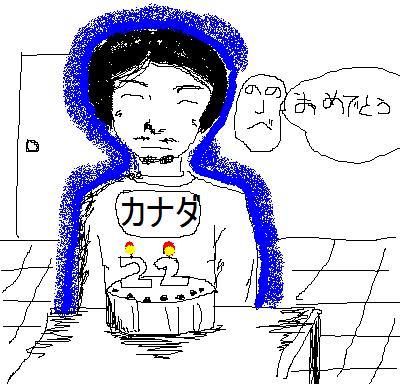
I'm 22 now, and I'm firmly stuck on the ground.
When I was a child, I was just a kid living day to day, wondering whether I would get a new toy tomorrow. Today, I'm living the dream of the archetype worker slave of Western Civilization. Live, Learn, Conform, Get a Job, Contribute, Die. Every day of my living existence I submit to the wiles and whims of my teachers, my superiors, my bosses. One large heirarchic tree stretching to infinity, with God at one end.
Congratulations to me - I am one year closer to my death. My hair's getting whiter by the day. I'm loading up on crap and toxic substances with every breath and every bite and every sip. I'm living my life, while dying at the same time, in every single second of my existence. It's a wonder what aging can do for you. When you were a child you believed in a great number of things, and as you grew older every one of those beliefs was thrown out of the window.
When I was a child I believed that tongue was spelled T-A-N-G. When I was a child I believed you can get pregnant from oral sex. When I was a child I believed that the SNES was the pinnacle of video game entertainment. I believed that whenever I watched Unsolved Mysteries or Inhumanoids an invisible hand would abduct me. I believed I was from Venus and was the reincarnation of a 600 year old person.
What I believed was nothing compared to what I learned. I learned that when you opened up yourself to another person you would get the world. I learned that friendliness and companionship are things not all people seek. I learned that when you opened up your feelings to different kinds of people, they shun you. I learned that one perfectly timed bad moment screws up everything. I learned that things like love are really amoral, and that people can do evil things in the name of love, while at the same time people can do the greatest things in the world because of the same reasons. I learned that there are some things that cannot be fixed. I learned that miracles do happen, despite that. I learned not to close my mind. I learned that Samm Schwartz died years ago, and I will never see another original Jughead strip from him again. I learned that time is relative, fleeting, precious.
I learned that even if I could never truly fly, I could try.
Here's to one more year of existence. Happy birthday to me b(^_^)d
Friday, September 23, 2005
WORD LIFE!
 I made this.
I had a really, really bad day today, and I have no one else but myself to blame. So I made this as therapy.
I think I may need psychiatric help...
WORD LIFE!
till next time.
p.s. I'm getting addicted to the theme song of Samurai 7, Nanase Aikawa's UNLIMITED. It has a really cool tune.
Tuesday, September 20, 2005
A love not so ordinary
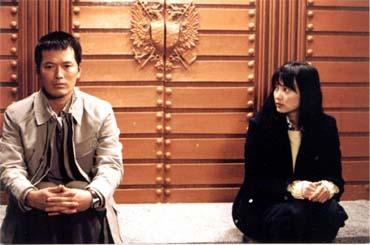 One of the specialties of Korean filmmakers is genre cinema, and one of their most liked genres (at least by mainstream audiences) is the romance film. Be it a rom com or a straight melodrama, Korean films have been tugging the heartstrings of people for quite a while.
The premise is so commonplace it's almost formulaic. Take rom-coms for example: A person who looks absolutely fantabulous (handsome or cute, depending on the situation,) who may or may not be sassy, befriends a person of the opposite gender in an incident that may be attributed to chance. The actor/actress portraying this character may have acted in numerous pretty boy roles, or in the case of a woman, may have a great number of cosmetic commercials. Slapstick may or may not ensue, which often involves the slapping of heads (we call this batok) and other inventive situations. After a long segue of fun interactions, which may consist of trips to some place of amusement, a freak melodramatic moment completely reverses the tone of the film at the last 2/3, which eventually resolves itself in a more or less happy ending thanks to a resolution. Oh, and 4 times out of 5, the two leads have known each other somewhere before, either as childhood friends or highschool classmates.
You've seen that, right?
What if someone screwed all of that up?
What if actor NOT known for playing pretty boy roles (Jeong Jae-yeong) is the male lead? What if the actress in the female lead, albeit pretty, looks like some normal person you can see in the street? (Although she still looks great in some shots.) What if the freak melodramatic moment happens in the first 10 or so minutes of the movie?
Director Jang Jin, who would later go on to have a hand in two of the biggest movies of 2005 (Welcome to Dongmakgol, which he wrote, and The Big Scene, which he directed) posed this question. The product is Someone Special (a.k.a. A Woman I Know,) a quirky, fun satire of the romantic comedies that have plagued Korea since the advent of My Sassy Girl.
Jeong Jae-yeong is Chi-sung, a down and out baseball player who has faced rejection one too many times. When he finds out he has lung cancer, he lives his life with abandon, since nothing really matters. He meets Yi-yeon, a slightly nervous, quirky bartender at a bar near his house. It's obvious that Yi-yeon is into him (she even carries him to a motel - stuffed into a box) but he doesn't care, since he's going to die. Eventually they get into various unconventional situations of their own, as Chi-sung tries to find out what love really is.
The film's parody of the Korean rom com genre is evident, especially in it's "Movie-within-a-movie" sequence, which I like to call "Telephone Pole," where Chi-sung frequently berates the movie, perhaps also due to his own disenchantment. Later on in the movie, when faced with a dramatic situation, Chi-sung does the same thing the guy in that movie did, hoping that somehow a miracle will happen, which is typical of many movies of this type. After a few moments however, it is apparent that nothing will happen... or are we led to think that way?
Ironically, although the movie deconstructs the genre, it also adheres to some of the elements it satirizes. The point of the movie is then made a bit more complicated by the notion that from a simple satire of the genre the movie makes itself an (albeit strange) example.
Jang Jin shows his talent for comedy here, using well-placed editing techniques and impeccable timing from the actors for comic effect. Speaking of the actors, the two leads are nothing if not unconventional, but they show an interaction and innate chemistry that enhances your perception of the film as a whole.
By the end of the film, we are left to ask for ourselves: what is love? The movie, through Chi-sung poses that question throughout the movie, but we can easily say that all of the opinions expressed in the movie are true. When you fall in love, it just happens. Love is... just love, is it not?
Monday, September 19, 2005
La Dolce Vita

After the success of A Tale of Two Sisters, a complex psychological film with horror elements, Kim Jee-woon returns to the scene with his latest film A Bittersweet Life. Touted as an action noir film, the film is ultimately a visually lavish way to tell a deceptively simple story.
Sun-woo is calm, cool and collected. As a bodyguard in some sort of gang, he's the right hand man of Kang, the Boss. Sun-woo seems detached from the rest of the world; he's like a passenger riding along with life as the scenery. He lives a carefully ordered life, a straight line that has no diversions. The Boss likes this for obvious reasons, and one day he orders him to watch over his girlfriend. If Sun-woo finds her cheating, he must either kill her or inform him. This sets a chain of events that leads to the destruction of Sun-woo's perfectly ordered life.
The premise of the story is pretty simple, and is typical of the noir genre. The great characterization of Sun-woo shines trhough; this is truly a movie about him. When the first cracks in his life manifest, he reacts with a fury that he has hidden for perhaps all his life. He spends the next hour or so unleashing this pent up emotion in various stylish and creative scenes. This may be the film's greatest strength as it is it's weakness - it may be very well done, but the film is too typical, and when you watch it you get the feeling that it has already been done before.
The ultimate irony in the film is that Sun-woo himself doesn't know exactly why he undertook this path of bloodshed; he just committed to it, and that was that. Of course, we all know why he did the things that he did (or do we?) but Sun-woo, we theorize, has never experienced these feelings before. His conflict spans the film as well. At the end he has finally realized what it was all about, and accepts whatever comes to him.
Apart from everything else, the film is visually one of the best of the year. Big props (is there a pun in here somewhere?) to Ryu Seong-hee, who designed the sets for this film. If the visual style looks similar, she also worked on Oldboy. Kudos also goes out to the editing of certain scenes in the movie. At one point when Sun-woo looks after the Boss' girl, we see a flash of a scene of swaying trees (were those bamboo trees?) seen earlier in the movie, a kind of leitmotif similar to the cloud formations in Akira Kurosawa's Ran.
Some call this movie "The next Oldboy" or an Oldboy clone. I think that doesn't hold much ground aside from the stylistic violence or the basic plot thread. Oldboy was about revenge; A Bittersweet Life has revenge secondary to the main point of the film: "The sweet will never be sweeter without the sour."
Or something like that.
Sun-woo is calm, cool and collected. As a bodyguard in some sort of gang, he's the right hand man of Kang, the Boss. Sun-woo seems detached from the rest of the world; he's like a passenger riding along with life as the scenery. He lives a carefully ordered life, a straight line that has no diversions. The Boss likes this for obvious reasons, and one day he orders him to watch over his girlfriend. If Sun-woo finds her cheating, he must either kill her or inform him. This sets a chain of events that leads to the destruction of Sun-woo's perfectly ordered life.
The premise of the story is pretty simple, and is typical of the noir genre. The great characterization of Sun-woo shines trhough; this is truly a movie about him. When the first cracks in his life manifest, he reacts with a fury that he has hidden for perhaps all his life. He spends the next hour or so unleashing this pent up emotion in various stylish and creative scenes. This may be the film's greatest strength as it is it's weakness - it may be very well done, but the film is too typical, and when you watch it you get the feeling that it has already been done before.
The ultimate irony in the film is that Sun-woo himself doesn't know exactly why he undertook this path of bloodshed; he just committed to it, and that was that. Of course, we all know why he did the things that he did (or do we?) but Sun-woo, we theorize, has never experienced these feelings before. His conflict spans the film as well. At the end he has finally realized what it was all about, and accepts whatever comes to him.
Apart from everything else, the film is visually one of the best of the year. Big props (is there a pun in here somewhere?) to Ryu Seong-hee, who designed the sets for this film. If the visual style looks similar, she also worked on Oldboy. Kudos also goes out to the editing of certain scenes in the movie. At one point when Sun-woo looks after the Boss' girl, we see a flash of a scene of swaying trees (were those bamboo trees?) seen earlier in the movie, a kind of leitmotif similar to the cloud formations in Akira Kurosawa's Ran.
Some call this movie "The next Oldboy" or an Oldboy clone. I think that doesn't hold much ground aside from the stylistic violence or the basic plot thread. Oldboy was about revenge; A Bittersweet Life has revenge secondary to the main point of the film: "The sweet will never be sweeter without the sour."
Or something like that.
Tuesday, September 13, 2005
Venice, Venice...
The Venice Film Festival is done, and the list of winners is interesting.
The Golden Lion for Best Film went to Ang Lee's Brokeback Mountain. Played by Heath Ledger and Jake Gyllenhaal, the movie is about a story between two cowboys living in the grasslands of Wyoming in the 60's. It's a love story as well. Yep - that's between two men. I wonder how they managed to pull this off.
The Silver Lion for Best Director went to Philippe Garrel for his work on the three-hour Les Amants réguliers, about a group of students amidst the May 1968 French riots - an idea that has been touched on by filmmakers such as Bernardo Bertolucci in his film The Dreamers and Jean Luc Godard in one of his works whose name eludes me. The film also won a technical award for its cinematographic proficiency.
The Jury Special Prize went to Mary, a film from Abel Ferrara starring Juliette Binoche and Matthew Modine. It's about how Binoche's character, an actress, turns to God after portraying Mary Magdalene in a film made by Modine's character.
George Clooney's biopic on Edward R. Murrow, entitled Good Night, and Good Luck won the Best Actor award for David Strathairn, who played Murrow, and the Best Screenplay award for Clooney and Grand Heslov.
The Best Actress went to Giovanna Mezzogiorno for her role as Sabina in Cristina Comencini's La bestia nel cuore, adapted from Comencini's own novel. I thought Lee Young-ae would clinch it, but anyway...
The Best Young Actor or Actress award went to, Ménothy Cesar in Vers le sud, by filmmaker Laurent Cantet.
Park Chan-wook's film Sympathy for Lady Vengeance won three out of competition awards, which I think was pretty impressive. Takeshi Kitano's new film Takeshis' was well received but I don't think it won anything.
Well, time to get that A Bittersweet Life review out of the closet. See ya in a few.
The Golden Lion for Best Film went to Ang Lee's Brokeback Mountain. Played by Heath Ledger and Jake Gyllenhaal, the movie is about a story between two cowboys living in the grasslands of Wyoming in the 60's. It's a love story as well. Yep - that's between two men. I wonder how they managed to pull this off.
The Silver Lion for Best Director went to Philippe Garrel for his work on the three-hour Les Amants réguliers, about a group of students amidst the May 1968 French riots - an idea that has been touched on by filmmakers such as Bernardo Bertolucci in his film The Dreamers and Jean Luc Godard in one of his works whose name eludes me. The film also won a technical award for its cinematographic proficiency.
The Jury Special Prize went to Mary, a film from Abel Ferrara starring Juliette Binoche and Matthew Modine. It's about how Binoche's character, an actress, turns to God after portraying Mary Magdalene in a film made by Modine's character.
George Clooney's biopic on Edward R. Murrow, entitled Good Night, and Good Luck won the Best Actor award for David Strathairn, who played Murrow, and the Best Screenplay award for Clooney and Grand Heslov.
The Best Actress went to Giovanna Mezzogiorno for her role as Sabina in Cristina Comencini's La bestia nel cuore, adapted from Comencini's own novel. I thought Lee Young-ae would clinch it, but anyway...
The Best Young Actor or Actress award went to, Ménothy Cesar in Vers le sud, by filmmaker Laurent Cantet.
Park Chan-wook's film Sympathy for Lady Vengeance won three out of competition awards, which I think was pretty impressive. Takeshi Kitano's new film Takeshis' was well received but I don't think it won anything.
Well, time to get that A Bittersweet Life review out of the closet. See ya in a few.
Saturday, September 03, 2005
Feeling Lousy...
The title says it all. Thus, I have changed my title picture thingy to suit the mood. Sympathy for Mr. Vengeance is a cold, calculating foray into the depths to which anyone can go given the right circumstances - ironically, in this movie's case, out of love. Once I've seen Sympathy for Lady Vengeance I'll do a little feature on all three of Park Chan-wook's "vengeance" movies.
Until then, let me wallow in my sorrow just a bit more...
Until then, let me wallow in my sorrow just a bit more...
Wednesday, August 31, 2005
A Wandering Stare

When I finished watching Lee Yoon-ki's debut film This Charming Girl last Saturday, I didn't know what to say about it. Some parts seemed extraneous somehow and the film as a whole didn't seem to coalesce into something tangible. I couldn't see what everyone was talking about that made the film so good.
Over the course of the next days, however, I couldn't stop thinking of this film. By the next day, my opinion of this film changed vastly, and I now consider the film to be one of the best of the year. Quiet, delicately restrained and contemplative, This Charming Girl is an interesting picture into the psyche of a woman struggling to break free.
Break free from what, you may ask? You'll have to see the movie to find out. The movie begins with us seeing the main character, Jeong-hye (portrayed superbly by Kim Ji-soo in her first film role,) going through the motions of everyday life. She works as a postal worker, quietly going through her days silently toiling, seemingly aimless. As the movie progresses, we notice that something is different with Jeong-hye. She spends moments of quiet contemplation, and sometimes engages in strange little things like impulsively buying kimchi from home shopping. Director Lee states that it's not that Jeong-hye couldn't make kimchi for herself, it's more of the fact that she's curious and wants to try it out on a whim.
She takes this attitude to a new level when she decides to take a chance. As we see how she deals with the repercussions of this act, we see more and more through the layers of her past and the things that has shaped her life up until now. What we see by the end of 99 minutes is a small glimpse into someone's heart.
The camerawork in this film is very interesting, to say the least. There are lots of handheld shots (I wouldn't be surprised if I found out the entire film was handheld) and lingering static shots with a good eye for composition. I also noticed that there are few long-distance, wide angle shots in the movie (I counted 10, give or take a few.) Most of the scenes lavished its attention on Jeong-hye, her face, her expressions, her little motions and quirks, never capturing her more than a few meters away, giving the film a slightly voyeuristic (or personal, depending on your interpretation) feel. But this is her movie, after all.
Some people may be put off by the languid pace the film takes; I do admit that watching a movie like this takes a bit of patience, but in my opinion the payoff is extremely rewarding.
As the film cuts to a final shot of Jeong-hye's face, we try to find the meaning in her expression. Was it sadness? Or was it the promise of hope? Lee wisely lets us make the decision ourselves; or perhaps we can say that Lee leaves it to Jeong-hye - in the end, it's ultimately her life.
Break free from what, you may ask? You'll have to see the movie to find out. The movie begins with us seeing the main character, Jeong-hye (portrayed superbly by Kim Ji-soo in her first film role,) going through the motions of everyday life. She works as a postal worker, quietly going through her days silently toiling, seemingly aimless. As the movie progresses, we notice that something is different with Jeong-hye. She spends moments of quiet contemplation, and sometimes engages in strange little things like impulsively buying kimchi from home shopping. Director Lee states that it's not that Jeong-hye couldn't make kimchi for herself, it's more of the fact that she's curious and wants to try it out on a whim.
She takes this attitude to a new level when she decides to take a chance. As we see how she deals with the repercussions of this act, we see more and more through the layers of her past and the things that has shaped her life up until now. What we see by the end of 99 minutes is a small glimpse into someone's heart.
The camerawork in this film is very interesting, to say the least. There are lots of handheld shots (I wouldn't be surprised if I found out the entire film was handheld) and lingering static shots with a good eye for composition. I also noticed that there are few long-distance, wide angle shots in the movie (I counted 10, give or take a few.) Most of the scenes lavished its attention on Jeong-hye, her face, her expressions, her little motions and quirks, never capturing her more than a few meters away, giving the film a slightly voyeuristic (or personal, depending on your interpretation) feel. But this is her movie, after all.
Some people may be put off by the languid pace the film takes; I do admit that watching a movie like this takes a bit of patience, but in my opinion the payoff is extremely rewarding.
As the film cuts to a final shot of Jeong-hye's face, we try to find the meaning in her expression. Was it sadness? Or was it the promise of hope? Lee wisely lets us make the decision ourselves; or perhaps we can say that Lee leaves it to Jeong-hye - in the end, it's ultimately her life.
Monday, August 29, 2005
Say you, say me part 2: Rikidozan
 When I see professional wrestling on TV, I still see, after almost two decades, the flashiness, the electricity in the air, the soap opera style sketches. I was a fan for a long time; as kids and teens we lapped up the suspense and the matches and cheered our favorite wrestlers on.
In Japan, professional wrestling (contracted into "purores") is considered as a more serious sport. Wrestlers are treated more like sports athletes than entertainers. One even got into the Japanese Government, no less wearing his trademark mask.
The man who almost single-handedly brought pro wrestling to Japan was a man called Rikidozan. How interesting it is to note that Rikidozan, a man who is considered a national hero in Japan is actually from Korea.
Rikidozan the movie is a biopic, but it does try well to get out of the pitfalls that other movies of its type suffer. We see Rikidozan as a man beset by faults, but striving for a place in the world. Or perhaps we can say that all he wants is a world where he won't be judged because of his race or creed.
Some of the more enjoyable scenes in the movie occur when Riki fights his first match in Japan. At the time Japan was a wreck after losing WWII, most importantly with respect to morale. I noticed that the announcers talked about the match in this way: they didn't refer to Rikidozan "beating up Mr. this and that," but rather of Rikidozan "defeating America." It was a great source of pride for the Japanese people, giving them something to hold on, something with which to save face, for a country obsessed with saving face and personal honor.
No, Rikidozan was not a perfect person. His love story with his wife Aya, portrayed by Japanese actress Miki Nakatani (Chaos, Ring 2) may be a bit underplayed but it works, for what it's worth.
I am now in the opinion that Sol Kyung-gu is in the top tier of actors in Korea, if not Asia, if not the world. He gives the character Rikidozan life, a marked contrast from his roles as a mentally impaired person in Oasis or as a suicidal man in Peppermint Candy. His usage of Japanese is quite good from my reckoning, and I probably wouldn't have known that he was a Korean actor had I not known.
In the end, Rikidozan was a good effort. It may not have been a perfect film, but it competently shows the quest of a man whose only wish was to be able to smile as much as he wanted.
Thursday, August 25, 2005
Say you, say me, part 1: 2009 Lost Memories
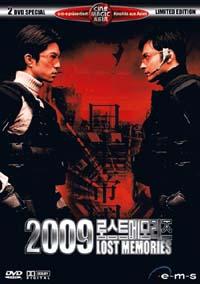 Why, you may ask, "say you, say me?" Well, the next two movie reviews are going to tackle two movies that have something in common: they are movies with Korean actors in Japanese-speaking roles, and the setting is either Japan or a colony of Japan. Can't make the connection? Neither can I. :p
First up is 2009 Lost Memories, starring Jang Dong-geun and Toru Nakamura. The premise of the film is very interesting.
Here goes. In 1910, Korea was under Japanese rule. This all changed when a man named Ah Jung-geun killed Prince Ito Hirobumi, then Governor General of Korea. This later lead to many uprisings that eventually led to the Annexation of Korea in the same year.
The film poses the question: what if the assassination attempt failed? An amazing sequence of parallel history shows us what could have happened. The movie then begins in Seoul, but as soon as I saw the city, everything felt different. When I saw the Japanese-style police cars and the suits, I knew that this was a different Seoul, a different world.
The immersion is what matters in a film like this, and although it does start very well, the immersion wasn't as good as it was at the beginning once you get to the movie's second half. Jang Dong-geun does a decent job speaking Japanese, but I kinda felt the accent still shining through. It is a challenge speaking a different language, so I do commend him on his effort. The rest of the actors there only have supporting roles, perhaps except for Jang's partner Toru Nakamura, who does a decent job whenever he is on the screen.
The action scenes were okay, although there was nothing special in them. No wirework, no bullet ballet, just people shooting each other a whole lot. The special effects are quite commendable for a Korean movie and are a service to the story.
There aren't many sci-fi films in Korea. Perhaps people were still reeling from the massive box office faliure that was The Resurrection of the Little Match Girl back then. I can only name Natural City and Wonderful Days as truly sci-fi themed films released since then (does Yesterday count? I'm not really sure...) 2009 Lost Memories is a great effort to make a Korean sci-fi movie that works. Well it did, earning a good deal of money, but the costs offset it. Hopefully soon Korea will start its true foray into sci-fi. I'm looking forward to what the results could be.
Sunday, August 21, 2005
Paradise Lost
 Much has been said about Masamune Shirow's other epic influential manga, Ghost in the Shell. That manga, and the anime movie and television series that followed it, helped popularize and revolutionize the anime phenomenon.
That isn't Shirow's only manga, however. There is one manga that he considers his "life's work-" that manga is Appleseed. Still ongoing after around 20 years (and uncertain if it will be finished at all) it is a deep reflection on man, technology and society.
An anime adaptation was made, if I recall correctly, in the early nineties, and it wasn't all that good. The story was taken out in favor of the angst and action - and considering that what was left was mediocre animation, it wasn't all that appealing.
Years later, I found out that there was a second adaptation of Appleseed, and when I saw the trailer, I was stunned. Unlike the full CGI approach that movies like Final Fantasy The Spirits Within took, Appleseed took the approach of cel-shaded 3D graphics, used previously, to my knowledge, only in videogames like XIII.
Having seen the movie, my verdict is: the movie looks spectacular, but if you're looking for a deep story, there's none of that here.
Appleseed takes us to the future earth of 2137, where man has almost driven itself to extinction. In a bleak, devastated field of battle (in a spectacularly choreographed scene that shows us how to use slow mo the right way) a warrior named Deunan Knute is rescued. She is taken to Olympus, one of the last refuges of man, a city that looks like paradise... at first. In this land humans and artificial creations called bioroids live side by side. But there are forces that conspire to destroy this balance between human and bioroid. Deunan and her former partner (and lover?) Briareos Hecatonchires team up to find out who before a terrible mass murder is committed, as well as uncovering the secret of Appleseed.
Visually, this movie is, for lack of a better term, gorgeous. The CGI is astounding, a significant leap over previous Japanese attempts at CGI (Visitor and A.Li.Ce come to mind) The ocean scenes showcase the added visual power the movie has in comparison to its predecessors. The climactic final scenes are fast and are a delight to watch.
The pulse-pounding soundtrack is excellent - while it lasts. Somewhere in the last quarter of the movie, the frenetic electronic tracks are replaced with much more standard action movie soundtrack fare, only to reappear in the opening credits. I wish the whole film was included in the soundtrack - it gave the first 3/4ths of the movie life.
The story, unfortunately, is where the movie begins to falter. The scenes feel too tacked on with respect to each other. It feels like a cliff's notes version of the manga - and even then, it takes a lot of liberties with the original material. More importantly, the philosophical discussions and overtones of the manga have been all but omitted in the film - and that's what Shirow's manga in general has in substance: the complicated politics and sci-fi metaphysical musings.
Appleseed succeeds in being a revolutionary movie in terms of visuals, but in everywhere else, it's your normal anime movie. Sadly, this trend has been seen in several other anime as well, and the use of cliche may not be as appreciated by some audiences. For me, however, it turned out to be a very satisfactory experience all around. Watch out for it, if just for the eye candy.
p.s. speaking of eyecandy, Appleseed 2 is in the works. John Woo is reportedly producing. Not to be outdone, Square is releasing the much antipated CGI-animated sequel to Final Fantasy 7 - Final Fantasy Advent Children. The movie premiers in the Venice Film festival at around this time. I've seen the trailer and I was pretty much blown away...
Thursday, August 18, 2005
Oh $#!t, did that guy just jump through a...
 Banlieue 13 is enjoyable, just like Yamakasi, (another Luc Besson produced movie) is enjoyable. If you enjoyed Yamakasi you will probably enjoy this one a lot more. This is a stylish French action movie if I ever saw one, and kinda goes like the French version of Ong Bak. Heck, the people who made this film probably saw Ong Bak (I'm certain at least Luc Besson did) and said "Holy $#!t, did that guy just jump over a ****ing SEDAN and hit a guy in the head with his ELBOWS!?" and then made a smooth comeback by saying "Hey, we can do that too."
The plot is paper thin, but that really isn't the point. It's the future and areas with rampant crime are being sealed off. Banlieue 13 is such a place. Things have gotten so rough even the police are abandoning the area. A cop (Cyril Raffaelli, who had a villain's role in the Jet Li movie Kiss of the Dragon) is tasked to go to the area to prevent a neutron bomb from killing everyone. Of course, he won't get through the area without a guide, and Leito (David Belle, who had a few bit parts in the Palestinian Movie Divine intervention and Brian de Palma's Femme Fatale) is just the man for the job. He has a bit of a past with the man who has the bomb, so naturally he's eager to kick some ass.
And action ensues. The action is stylish. Mix Ong Bak (without the muay thai) with Yamakasi and you basically have it. Climbing buildings without support, kicking people's asses, jumping from building to building, that's what it's all about. The two lead actors kick ass in their respective scenes, but the scenes at the first 50 or so minutes are better and more numerous than the scenes in the rest of the film. That's okay, since the movie is only 85 minutes long, but it does affect the flow of the story.
Soundtrack: synth and some French rap. French rap, mmmm! Aristocratic. The camerawork is kinetic and serves the action well, which is all it needs to do.
This is by no means a thought-provoking action movie that transcends our minds, blah, blah, blah. It's merely a fun way to spend 85 minutes of your time with great action and death-defying stunts - like I said, just like Yamakasi. Believe me, if you're like yours truly, you'll spend many a time saying the words of the title of this post, stupefied and entertained.
INSIDIOUS
I was walking around the mall and passed by a McDonalds. Guess what I saw in an ad DIRECTLY IN FRONT OF THE STORE.
That's right, an ad for Jollibee.
INSIDIOUS.
I was at one of the Pediatrics wards of the Philippine General Hospital (there are 2) and the place is newly renovated. I walk around and see sick kids (natch.) Then I see that the people responsible for the renovation is McDonalds. Hence the garish McDonalds colors, and the pictures of Ronald and the kids sprinkled all around the wards.
of a hospital. See you later, kids!
the PGH have no money to speak of so it's kinda understandable, but from a marketing standpoint...
that's horribly clever.
...and
INSIDIOUS.
I went to McDonalds yesterday, ate one of those double cheeseburgers. Mmmmm-mmmm. Did I have a choice? No, everywhere else was full. Did I enjoy the meal? Hell yes. For a slab of processed meat n'cheese in a bun, that was damn tasty. I kinda want another one.
INSIDIOUS.
That's right, an ad for Jollibee.
INSIDIOUS.
I was at one of the Pediatrics wards of the Philippine General Hospital (there are 2) and the place is newly renovated. I walk around and see sick kids (natch.) Then I see that the people responsible for the renovation is McDonalds. Hence the garish McDonalds colors, and the pictures of Ronald and the kids sprinkled all around the wards.
of a hospital. See you later, kids!
the PGH have no money to speak of so it's kinda understandable, but from a marketing standpoint...
that's horribly clever.
...and
INSIDIOUS.
I went to McDonalds yesterday, ate one of those double cheeseburgers. Mmmmm-mmmm. Did I have a choice? No, everywhere else was full. Did I enjoy the meal? Hell yes. For a slab of processed meat n'cheese in a bun, that was damn tasty. I kinda want another one.
INSIDIOUS.
Tuesday, August 09, 2005
Read or Die
No, this is not about the anime series. For the past week I've managed to read three books. Two of them in two days. This is good, right?
The first book I read in my book binge was Alex Garland's The Coma. It's beautifully illustrated and well-written. However, it doesn't last very long - then again, what does? A good imagination makes this book even better.
The second was Mitch Albom's The Five People You Meet in Heaven. Also short (I read it in around three to four hours, including breaks) it's sentimental and nice, although there is one mistranslation of Filipino in the final chapter.
The third was Morgan Spurlock's Don't Eat This Book, which is sort of a companion piece to his film Super Size Me. He makes some salient points about the food industry, and how we are bombarded with ads ever since birth. It's all a business thing. Ironically, the first thing I did after buying this book was go to a McDonalds. Heh.
Well, until next time...
The first book I read in my book binge was Alex Garland's The Coma. It's beautifully illustrated and well-written. However, it doesn't last very long - then again, what does? A good imagination makes this book even better.
The second was Mitch Albom's The Five People You Meet in Heaven. Also short (I read it in around three to four hours, including breaks) it's sentimental and nice, although there is one mistranslation of Filipino in the final chapter.
The third was Morgan Spurlock's Don't Eat This Book, which is sort of a companion piece to his film Super Size Me. He makes some salient points about the food industry, and how we are bombarded with ads ever since birth. It's all a business thing. Ironically, the first thing I did after buying this book was go to a McDonalds. Heh.
Well, until next time...
Monday, August 01, 2005
One musing for the week:
... and this is going to be strange and in the end will sound more like a weird ramble than anything else. I don't have a lot of time, so here goes:

Okay, this is Anna Ohura, an AV actress (adult video, another term for porn actress) in Japan from the late nineties, early turn of the millennium, reportedly mixed Japanese and European blood, with huge natural breasts. I mean huge.
But that's not my point. I've been seeing her... "work" for the past few years and why is it that everytime I see her (well, around 75 percent of the time) she has this look, which can only be adequately described as a mixed confused/annoyed look. In Filipino it would be called nakakunot ang noo. Can't visualize? Here's an example:

This look has been baffling me for years. What does it mean? Is she annoyed at her male counterpart's insufficiency? Is she thinking to herself, "what the hell am I doing here?" Is the camera making her insecure? Are there spectators around, and are they making her insecure? Is that her "thinking deeply at the course of my life" look? Is she confused? Annoyed? A combination of the above? Does she have chronic back pain? More than half a decade of looking and I have no idea. Note that this look doesn't show up in still photographs, only in video, only live.
Ladies and gentlemen (especially gentlemen,) AV stars are people too. They think about various things in their life. This look may entail a deeper meaning for all of us.
That, or I'm just insane. I'm leaning towards the latter.

Okay, this is Anna Ohura, an AV actress (adult video, another term for porn actress) in Japan from the late nineties, early turn of the millennium, reportedly mixed Japanese and European blood, with huge natural breasts. I mean huge.
But that's not my point. I've been seeing her... "work" for the past few years and why is it that everytime I see her (well, around 75 percent of the time) she has this look, which can only be adequately described as a mixed confused/annoyed look. In Filipino it would be called nakakunot ang noo. Can't visualize? Here's an example:

This look has been baffling me for years. What does it mean? Is she annoyed at her male counterpart's insufficiency? Is she thinking to herself, "what the hell am I doing here?" Is the camera making her insecure? Are there spectators around, and are they making her insecure? Is that her "thinking deeply at the course of my life" look? Is she confused? Annoyed? A combination of the above? Does she have chronic back pain? More than half a decade of looking and I have no idea. Note that this look doesn't show up in still photographs, only in video, only live.
Ladies and gentlemen (especially gentlemen,) AV stars are people too. They think about various things in their life. This look may entail a deeper meaning for all of us.
That, or I'm just insane. I'm leaning towards the latter.

Subscribe to:
Posts (Atom)