rotban

Friday, March 31, 2017

Hiwaga is mostly nonsensical sap

Hiwaga; Ang Paglalakbay sa Hiwaga ng Buhay is about a faith healer woman who receives her power from nature spirits. Although they pray to God (?) or something, they mix pagan beliefs into the whole mix, which is kind of the norm for a lot of people. 

She takes care of four children; John Estrada (no relation to the actor), Lorraine, Hannah and Princess. Their mother teaches them the title song (which they master, probably with blending techniques,) after only hearing it once. Because, apparently, why not. The film makes the lazy narrative decision to let the mom do the character establishment by enumerating the main characters' names and all their positive qualities through dialogue, something that no human being would do in real life.

Predictably, the mother dies, and the children go through what can only be called the surefire go-to talent portion shtick for contestants of That's My Boy and Little Miss Philippines: acting as if their mother had died. Of course, she doesn't die immediately, as they bring her to the mountain because she needs to drink the healing water or something. She dies anyway because apparently that shit don't work if you're actually dying.

The four kids are separated but eventually reunited through rather serendipitous means, mostly through the power of Facebook stalking and the titular song, which, in the course of viewing this movie, you will hear approximately 9000 times (gross estimate.)

The movie isn't really compelling, and the majority of its running time is dreadfully boring. For most of the middle half of the film it's boring, inconsequential stuff about a high school trip to the mountains. Here, John Estrada goes to the place where he grew up and things happen. None of the other characters in this trip are of any consequence, and they are ignored later on. The nature spirits also make an appearance, but are also quickly ignored as the film goes on. (They aren't even in the finale.)

As the poster politely tells us, the entire film is based on the song by "Sir RCA", who directed this film. To be fair, it's slightly catchy. But to make up a story about faith healers and separated orphans from the song requires one hell of an imagination, because even the lyrics have barely anything to do with the plot of this film.

Hiwaga is not a very good film, but it's not as bad as some of the other garbage I saw this year. It seems to be a showcase of talent for all of the kids working under the talent agency that produced the film. This is not an uncommon occurrence, as it was also done with films like Dota: Nakakabaliw (okay, probably not the best comparison). But, like I said, the end product isn't very good. It's all sappy drama without rhyme or reason and characters that I don't really care about, based on a largely nonsensical story.

Saturday, March 25, 2017

The 2017 Power Rangers is basically a Tokusatsu Breakfast Club

If you've been reading this blog since the beginning, you'd know I'm a big fan of Tokusatsu, especially the Super Sentai and Kamen Rider franchises. So it's not an exaggeration to say this review comes with a bit more bias than usual. Upon watching the recent Power Rangers movie from Lionsgate, I was actually surprised at how much I liked it.


Power Rangers tells the story of a group of troubled teens, each with their own hangups and problems in life. And it's very well done. The actors, for one, are superb in their roles; and its obvious that the director was trying to get the feel of John Hughes' iconic teen film The Breakfast Club. While this movie is nowhere near as well made as Hughes' film, it's still pretty impressive for a genre remake. The Rangers feel like relatable human characters instead of cardboard cutouts. And I think films like The Breakfast Club are a perfect template to use for a movie like this: the teenage years are often a time when one tries to assert their own individuality; it's a time when some teens have the most difficulty trying to fit in, despite the fact that sometimes it's okay not to fit in at all. The Ranger suits/armor for me serves as a way for these teenagers to be who they really are - unique, nuanced individuals - in a sea of adolescent social hierarchies and cliques.

This focus on characterization makes you feel for the Rangers as the plot moves on to the spectacle of the third act of the film, where they do battle against original series antagonist Rita Repulsa (Elizabeth Banks). Here the tone shifts to what I've been accustomed to with Power Rangers the show and in Super Sentai. These shows are for the most part, catered to kids, and the show often mixes a tone that is over the top, silly and serious at the same time. There are a lot of silly jokes near the end of the film, and Banks hams it up as much as one possibly can. I think the filmmakers caught this tone very well, though the shifts may prove jarring for people not used to the show.

The movie does use nostalgia a bit, but in a very measured way. It does not point to the nostalgic material and go "hey, look at this! remember this? cool, huh?" Instead, it eases us into it as some sort of reward. It goes and tries to be its own thing without relying too much on other things, and that's something I think a lot of big franchise films tend to forget these days. It focuses on characters instead of setpieces, rare for today's movies that prefer spectacle and eyecandy and forced intertextuality.

The film does have its share of problems, I'll admit. I wish the film could have extended some of its action sequences, especially the fight on the ground with Rita's mooks. The movie also ends in a weirdly edited place, and the plot is pretty much a no-brainer. Despite that, I appreciate the simple approach taken with this film. If a sequel does get made, it will be interesting to see where the filmmakers take these interesting characters in something that's not an origin story, for one.

Thursday, March 23, 2017

Higanti, or how playing chess is the importantest

It's new movie timeeee. Today, we'll be talking about this gem, Higanti. I watched this film alone, and from all accounts the previous screening was probably as empty as the one I attended. This is evidence that normal people have the common sense and logic not to throw their money away. I envy them.

This movie, on the other hand, lacks both common sense and logic. It's poorly edited, with many scenes composed of random scenes spliced together. A dance scene, a scene where a young man furiously punches an easel and a scene where someone uses drugs are all shown in order, one after another. None of the scenes make any sense together or alone.

The story, which is about a woman who is basically shit on by her family for reasons, is poorly told. As a revenge film, it doesn't really dwell on revenge too much as it instead relies on letting things be. Which, as a revenge film (the film is literally titled "revenge" for chrissake) is the lamest thing you can do. It's so poor in almost all aspects of filmmaking it's actually quite amazing. Some people can't even try to be this bad. 

The writing is atrocious. There's a scene where the bitchy daughter (Meg Imperial) finally changes her ways. But the process of that change is so strange, so poorly implemented, that her character change is jarring. There's a motif of Gitana (Gypsy) dancing all throughout the film, but interpreting it as some sort of metaphor for the film is like saying quadratic equations are a metaphor for the Spanish Inquisition.

This is a film where someone is punched so hard, said punch-ee sprays so much blood (from where!?) drenching the punchers face in it.

This is a film where arterial spray from the neck has both the pressure and volume to coat an entire wall with blood almost instantaneously, thanks to piss poor editing.

This is a film with a hilariously bad CPR sequence, where the doctor is either 1) showing off 2) doesn't know what the fuck she is doing, or 3) both. She is defibrillating the patient's clavicles, after all.

This is a film where another doctor tells family members that their loved one is having a heart attack AGAIN in the most nonchalant, robotic way possible.

This is a film where a single shot from an M16 (NOT an M203, I checked) causes a large explosion in the water.

This is a film where a man tells the corpse of his dead brother that he can't die, because they still have to play chess. This is now the new "I'll never play the violin again!" and my new favorite line ever.

This is a film where an apparently bankrupt company has the money not only to buy juice and a cake, but also to remodel their entire building lobby, with nothing in the film telling us how the company got out of bankruptcy, if at all.

This is a film where said employees buy said cake and juice, but neglect to rearrange a burgled safe, just enough for our main character to see, instead of telling her that the safe has been burgled.

This is a film where establishing shots (or just random shots) are tilted at an extreme angle (90 degrees in some cases!) and spun around, because style is king, I guess.

This is a film where a man carves a deep wound into another mans chest, but the chest is merely smeared with blood seconds later.

This is a film where a bunch of guys piss on another guy's face in a slow mo/undercranked shot. Maybe these are the "understones" the MTRCB is talking about? You can take your 14 year old to see this film, by the way, since it's R-13.

This is a film where a "journalist" types with the typing speed of a three year old, capitalizing random words In His Sentences Like This. (Maybe he didn't read The Elements of Style.)

Higanti is garbage; an absolute failure of a film, and that's not really up for debate. But I really don't mind if people keep on making these shit films. I was in a bad rut today, and laughing (raucously, if I may add) at this film took me out of that rut. Not even Hollywood blockbusters managed to do that to me in the past few weeks. So thanks for that, I really appreciated it. Best film ever 10/10

Beauty and the Beast: a fairy tale

Once upon a time, there was a great animated movie from the kingdom of Disney. It was so good, it was hailed as one of the best in an era of bests, and was nominated for an Academy Award for Best Picture (not best Animated feature, mind you.) To John, it was one of his all-time favorite Disney movies.

Time passed, and the film aged well in the intervening time. John noticed that Disney was remaking its old animated movies into live action features, a trend that produced films such as Cinderella (2015), Maleficent (2014) and The Jungle Book (2016). The results ranged from meh to pretty great, so John had his reservations.

So it came to pass that John saw the new Beauty and the Beast live action film, directed by that guy who directed a number of Twilight films.  After seeing it, he generally appreciated what he saw, but he found something lacking.

Maybe, he thought, it was in the fact that certain things translate better through animation, where the CGI Beast ended up less expressive. Maybe, it was because of the bland color palette that consisted mostly of shades of dark blue and gold. Maybe, it was because he heard autotuning during some of Emma Watson's songs. Maybe, he surmised, it was because the most important scene in the film, the ballroom scene, felt flat and lifeless compared to the technical wonder of the cartoon.

And despite a plot that ties everything neatly together and new songs by original composer Al Menken, John thought the film was lacking when it was developing the most important part of Beauty and the Beast's plot, where the Beast warms up to Belle and vice versa, set to the song "Something There."

John exited the cinema and looked at the crowd who enjoyed the film. In trying to determine why, he searched far and wide within the landscapes of his mind and he realized that a wizard was casting powerful magic on these people. This wizard's name was Nostalgia. Nostalgia had been put to work by Disney before; exerting its power in the most recent Disney venture, that of a Rogue and her band of space misfits.

John admitted to himself, "The parts of this film that I enjoyed, the parts of the film that affected me the most were effective only because of that previous film. Without it, the film falls apart." And that, he realized, was the weakness of Nostalgia's magic. He imagined Nostalgia locked up in a corporate castle, forced to do the dirty work of unfeeling men in suits, with no prince or princess charming to save him. And that made John sad. He wished that one day, films can be made without relying too much on Nostalgia, because overused magical powers tend to weaken over time. Wishful thinking, maybe, but if love can turn beast into man, anything is possible.

Friday, March 17, 2017

March Reviews (2): Kong Skull Island, Get Out

Well, so much for my "hiatus."

On the surface, it's easy to judge Kong: Skull Island as a shallow monster movie. Its characters are mostly cardboard characters with little or no development - there's loopy scientist, decent civilian scientist 1 and 2, rookie-ish solider, hardened veteran with a past, photography girl and, of course, Samuel L. Jackson. Most of the meat of the story involves our titular gorilla punching and stomping and kicking ass, which is all well and good for popcorn entertainment. But Kong: Skull Island does something interesting with its story, one that has been remade many times since the original 1933 film.

The film draws from the time period it is set in - the 1970's - with visuals evoking the films and the filmmaking techniques of the time. Most obviously, the poster you see here is directly inspired by a similar shot in Francis Ford Coppola's Apocalypse Now.

And it's interesting how the film ties the conflict between our heroes and our beloved gorilla to the events of the Vietnam War, though it could apply to any war or conflict, past or present. It shows how the rational civilian population can be duped by the irrational whims of their leadership. It portrays Kong not as an amorphous villain, but as a fellow sentient being who we can get along with if we had the time to empathize, communicate and understand. It shows the lasting effects of the trauma of war on the soldiers that fight. It's also emasculating in a way, showing that blowing through everything willy nilly OR staying true to a lost cause is not always the proper course of action. These are lessons America could have learned over the course of that disastrous war, but these mistakes were repeated in their conflicts in Iraq and Afghanistan.

Despite all the silliness associated with the genre in the eighties and nineties, at its core, kaiju/monster movies often serve as a personification of society's boogeymen. In the 1950's, the Japanese used their own giant monster, Godzilla, to reflect their neuroses and trauma from the two nuclear blasts of Hiroshima and Nagasaki and the spectre of nuclear conflict that persisted all throughout the Cold War. Here, it's a very American take on the situation, baring the trauma to the American psyche through clever genre filmmaking.

Kong: Skull Island can be viewed as superficial B-movie-esque popcorn fun, relying on intertextual references ala Rogue One to keep viewers entertained. On the other hand, it can be viewed as a self examination of America's own deep scars.

Speaking of America's deep scars, Get Out, the directorial debut of comedian Jordan Peele, tackles that other giant elephant in the room: Racism. But Peele doesn't tackle the racism we overtly see. This isn't a movie about stereotypical, Trump supporting rednecks complaining that they "terk our jerbs". This is instead about a more insidious, normalized kind of racism. This is about a "benevolent" form of racism that is not really benevolent at all.

While the film sticks to the basics of the genre (jump scares and whatnot,) there's an atmosphere of awkwardness throughout the whole movie, making it extremely unsettling. Peele based the story of the film on his own anxieties when he would be the only black person in a social gathering, and you feel that anxiety when you know that something in this film is very, very wrong. The film wisely balances this dread with just the right amount of humor, thanks to a fantastic performance by Lil Rel Howery.

Peele (along with his comedy partner, Keegan-Michael Key) have always based their humor on observations on race and how it's still deeply rooted in society. Most of their skits in their comedy show Key and Peele tackle the same ideas as Get Out. See, just because America voted a black president into office (and would probably vote for him a third time if they could) doesn't mean racism is over. It just means that its roots will find less overt ways of manifesting in society.

I won't spoil the movie any more for you all, since I think watching this film blind is the best thing you can do. And do watch it, to gain a perspective on the nature of what racism is.

Monday, March 13, 2017

Sinag Maynila 2017 Festival Report


March marks the third edition of the Sinag Maynila film festival. We have five more full length feature films that are distinctly Filipino. This year, the results are mixed: one really good film, a couple decent films, and two films that I think will merit divided opinions.

I managed to see all five full length features, but I was unable to see the shorts and the documentaries, which seemed to be added to the festival as an afterthought (they were showing in only one cinema, for only a couple of days.) It's also weird in that one of the full length entries is itself a documentary. In any case, here are my thoughts on this year's Sinag Maynila 2017 films.

Let's start with the sole documentary in the full length feature category, Ricky Carranza's Beyond the Block. It serves as both historical chronicle and memoir, detailing the history of Pinoy streetdance and how it has evolved from a smattering of groups into a thriving culture of dance enthusiasts.

The film is divided into five chapters, each roughly covering a decade in the development of Pinoy Streetdance. The first two chapters, covering the seventies and eighties, are utterly fascinating, and the balance between memoir and history is kept. People who lived through these times might still remember shows like Dance 10 and the groups that participated in them, such as Carranza's own Funk System. For the nostalgia factor alone, this part of the film is worth the price of admission.

Once things get to the nineties, however, the historical material diminishes and the memoir aspect of the documentary takes over. This is where the documentary is at its weakest, and it's not helped by a tendency for the story to meander. For example, one sequence that involves a visit to Dubai (complete with epic intro) lasts only a minute at best, and is followed by a sequence that bears little to no relation to the topic at hand. It's kind of like listening to your Uncle tell you a story and he goes off on a tangent before returning to the story at hand.

While there are problems with how Beyond the Block is structured, it covers some really fascinating stuff, and is worth the watch if just for that.

Jason Orfalas' Ladyfish is not for everyone. Its brand of humor involves rather gross things that can offend a lot of people, including, but not limited to: goats, defiled vegetables and golden showers. I personally enjoyed the film, but felt a few things lacking from the final product.

Ladyfish takes the slice of life approach in depicting the everyday life of a gay man, Kaye (Martin Escudero) with a bunch of personal issues. He's visited by his transgender friend Bonn (Brenda Mage) who is in the middle of transitioning from male to female. Soon, the two of them, as well as Bonn's son, live together in a house.

That description is basically the whole movie, as Bonn and Kaye go about their daily lives with no real conflict between them. The movie does address a few issues regarding the discrimination of people from the LGBTQ community, but it doesn't materialize into anything that profoundly affects the story.

My main source of enjoyment from the film comes from the comedy, including a funny spoof of a scene from Lav Diaz's Hele sa Hiwagang Hapis. The ending of the film, which reveals something interesting about the film's characters, is interesting as well, although the beauty contest that precedes it feels a bit tacked on. Ladyfish may be entertaining, but at the end of the day, it simply goes nowhere.

I'm going to confess this to you guys right now: I have never seen a Joel Lamangan film that I've liked without reservations. This one comes pretty close, however.

Bhoy Intsik takes place in a typical Lamangan-esque world of social injustice and oppression, where savvy characters use their wits to survive. In this case it's petty thieves Marlon (Ronwaldo Martin) and the titular Bhoy Intsik (Raymond Francisco,) who strike up a strange friendship after fate intervenes in their lives.

There are some really good character moments between the two main characters of Bhoy Intsik, thanks to fantastic performances by Ronwaldo Martin (who basically does the thing he did in Pamilya Ordinaryo again) and Raymond Francisco, both of whom deserve awards for what they did in this film.

That said, the film is marred by a number of strange directorial and script decisions that suspend my disbelief and break my film viewing experience. First, living eye donations as depicted in the film don't really exist, unless there were some unethical black market shit going on. Second, one particular sequence in the film consists an absurd number of coincidences for the sake of plot development that just feels lazy. Third, some of the film's sequences are awkwardly edited, such as alternating shaky footage and static footage as reverse angles. The film lays on the EJK/Tokhang references really thick; the film is terribly unsubtle about it. Oh, and a suicide attempt is fixed in no time with no lasting emotional repercussions. O....kay.

Bhoy Intsik is watchable, if only for its two main characters. It's my least un-favorite Joel Lamangan film. If that makes sense.

Tu Pug Imatuy is, according to the poster, anyway, Manobo for "the right to kill." And when you give people the right to kill, that right tends to be abused.

The film tells the story of a Manobo family and their run-in with the military. To say anything more would spoil the experience, so I won't elaborate. Its mixed with some snippets of oral tradition, traditional folk music, and some really lush landscapes. It's no exaggeration to say the film is beautifully shot, probably one of this year's standouts in cinematography work.

The film's story is harrowing. It makes your blood boil in anger. But the most horrifying thing about it is that it's based on a true story, and that's scary as hell. The great cinematography works in the film's favor, as it provides a disturbing contrast to all the terrible things happening on screen.

The struggle of the Lumad has gotten increased attention in films these days with films like this and Chuck Gutierrez's Iisa, and I hope the trend continues. Tu Pug Imatuy is a story that chills your spine with the things it implies regarding our society. It's a story that needs to be heard.

Like Ladyfish, HF Yambao's Kristo also takes a slice of life approach, depicting a day in the life of a Kristo, or bet maker, in a local cockfighting arena. Unlike Ladyfish, however, Kristo is deadly serious.

Kristoffer King delivers yet another great performance as the titular Kristo. He's street smart and he knows the rules of the game. He's done these kinds of roles before, such as in last year's Purgatoryo and Dyamper, and as a whole, he's suited for the role.

Much like the cockfighting matches that happen in the film, the film's events depend largely on chance. Much of it is shot with an emphasis on realism, and makes no qualms showing these chickens fighting and killing each other.

My one real issue with the film is its ending; it seems really unnecessary and feels like an attempt to be edgy somehow. The story was otherwise compelling up to this point, but this just feels senseless. (The visual comparison was nice, though.)

In any case, the film is quite well made, and seeing the odds and ends of the cockfighting business is really interesting to watch. The film's characters and the capricious nature of fate only makes it look like the world's a giant cockfighting pit, and we're all gamecocks primed for a fatal game of chance.

***

That's it for Sinag Maynila, guys. I enjoyed this year's edition compared to 2016, to be honest, and I'm looking forward to future editions of the filmfest.

***

I'll be taking a short break from the blog to work on the anniversary special. I initially planned to not write anything in the interim, but I just realized there are a couple of really interesting films coming out in the next 2 weeks, and I might just be tempted to write sooner than expected. So thanks for reading, everyone, and see you all at the movies.

Sunday, March 12, 2017

March Reviews: Guardians and Pwera Usog

I'm just going to cut to the chase on this one: the Russian superhero film Guardians is terrible. Most of the film is incredibly boring and the action scenes are soporific. Most of the character development in this movie is established not through flashbacks or a cleverly structured plot, but by one on one conversations with the Guardians' perpetually smug commander.

The four Guardians have strange powers; one can use telekinesis but only on rocks, one can turn invisible, one has superspeed and one can turn into a bear. Oh, and together they can fire an energy ball for some reason. Go figure.

The local release of the film is dubbed, and it does not help the film one bit. The film employs a mix of practical effects and CGI. The CGI, especially for our bear friend, is particularly horrendous, while the practical effects and makeup, especially for the main villain, make him look like a bootlegged Michael Chiklis/Pillsbury Doughboy on steroids action figure.

This movie was definitely a disappointment. In the meantime, for some fun Russian action fantasy, try Nightwatch/Daywatch instead.

Pwera Usog is a fun horror comedy from Regal films. It begs comparisons to films like Evil Dead, Peter Jackson's Braindead, and the loopy local horror films of the eighties. It treats its material a bit tongue in cheek, and there's a distinct Filipino feel to the supernatural warfare being waged between a malevolent entity and a family of albularyos in the countryside.

The film makes the choice of having as its main protagonist one of the most unlikeable main characters of any film in recent memory. Jean (Sofia Andres) seems irredeemable based on her actions in the first half of the film. The script drops hints as to why she's acting this way, but it isn't really fleshed out. Once she has her redemptive moment by the latter half of the film, that moment feels unearned, because there isn't much of an established motivation for her to empathize and be altruistic towards the other main characters.

On the other hand, there's an interesting story that could have been told with the characters of Quintin (Kiko Estrada,) his adoptive mother (Aiko Melendez) and grandmother, and the identity of the mysterious entity causing the curse. It would have been interesting seeing the worldbuilding at play, establishing the rules of Usog and other faith healer things, like, say, how John Wick established its rules of killing in its world of assassins. The actions and backstories of Quintin and company are actually central to the film and its conclusion, but they're side characters for most of the film. Maybe for the sequel they can take a bigger role.

There are lots of surprises for casual horror fans, mostly jump scares and some creepy moments, but like I said, the movie adds a tinge of humor to the mix, so it's probably not horror like people are used to, which is a plus. I enjoyed Pwera Usog for what it's worth, and I'm curious how the world can be expanded further in possible future films.

Thursday, March 02, 2017

Logan:: Weapon X's Kingdom Come

James Mangold's second and final entry to the Wolverine movie series, Logan, is for all intents and purposes, an X-Men/Wolverine story told with the themes and story conventions of a Western. And to be honest, for a swan song to the character, there's no genre more appropriate.

The X-Men Western

Aside from its primary comic book source material (the Old Man Logan storyline), Logan borrows heavily from many films of the Western genre, especially the 1953 movie Shane, directed by George Stevens. (It's the western that we see prominently during some of Logan's scenes.) In both films, a wandering man, accustomed to the ways of killing, is given a task to protect someone or something. In Logan's case, it's young Laura Kinney (Dafne Keen), a mysterious girl with ties to Logan. It's a story that has been told numerous times before, not only in westerns, but also in films from other genres such as Lone Wolf and Cub, The Professional, and others. 

And it's clear that the protagonists of Logan are no longer the heroes they once were. Logan himself, now decades old, struggles with a weakened healing factor. He takes care of an elderly, senile Professor Xavier and is basically waiting for his time to die. Our protagonist, like many a Western anti-hero, is a troubled individual with a checkered past, but with a solid code of honor that he applies to those he protects - and that plays into the story in a big way.

And here's where the Western influences help. Logan takes places in a post-post apocalyptic world where mutants are almost extinct; there hasn't been a new mutant born in 25 years. The film is bathed in near-apocalyptic music and imagery: the vehicles in the desert reminds one of the first Mad Max film, and the film ends appropriately with Johnny Cash's The Man Comes Around, which is chock full of references to the book of Revelations:**

And I heard a voice in the midst of the four beasts,
And I looked and behold: a pale horse.
And his name, that sat on him, was Death.
And Hell followed with him. 

In comparison, the Western itself has dealt with such imagery, to envision a decline of the old world, where the notion of Cowboys and the Wild West become obsolete. You see it not only in movies, but also in Western-themed video games like Red Dead Redemption. In the same way, Logan heralds of the end of mutant heroes like the X-Men, in a world where they are nothing more than legends in comic books.

A War for the Future

In his book Supergods, prolific comic book writer Grant Morrison once said that he thought of mutant culture "not (as) a single monolithic ideal, or the warring ideologies of "evil mutants" and "good mutants," but as a spectrum of conflicting viewpoints, self-images and ideas about the future," and Homo Superior's struggle against Homo Sapiens as, and I paraphrase, the tendency of the parents to fear being co-opted by their children, and thus try to kill them off. This undercurrent of fear undercuts the motivations of Logan's antagonists, because people fear less that which they control.

In the same way, this war for the future drives our protagonist forward, if only thanks to Logan's code of honor. That's a part of what made him a hero in the first place, and that's what Marvel did so well with their characters during the Silver Age of Comic Books, where superheroes were not perfect gods, but people like you and me with their own notions of doubt and weakness.

Hugh Jackman brings this sense of humanity out in spades, delivering his franchise best performance (and a pretty memorable performance overall.) Jackman and Dafne Keen make their scenes work, developing their characters in effective ways. Patrick Stewart's last turn as Charles Xavier is heartbreaking and masterful as well.

Breaking the Mold

Aside from the obvious Western influences, the film does a good job distancing itself from the action spectacle of other Superhero films. In fact, it's a Superhero film that doesn't feel like one. Instead of bloated, briskly edited, CGI heavy action sequences filled with dozens of characters, Logan gets its job done with simple, cleanly edited, brutal action choreography. The film earns its R rating with the number of decapitated limbs and heads flying around at any one time.

Logan delivers a level of tension that I haven't felt in a Superhero film in a long time. While it could be trimmed a bit for time, none of the scenes were boring or unnecessary. It's a bit sad that this will be the last outing of Wolverine in this particular cinematic universe, as well as Hugh Jackman's last turn as the beloved character. But its sheer quality and craft make me hopeful for future X-Movies in a franchise that has grown less relevant in the shadow of other comic book movie franchises.

**even more relevant considering Mangold directed the Cash biopic Walk the Line in 2005.

Hihintayin Kita sa Langit (Restored Version)

Carlos Siguion-Reyna's Hihintayin Kita sa Langit is a strange film in today's context. It features the Richard Gomez--Dawn Zulueta love team, but instead of formulaic or relatively lighthearted fare, the movie is surprisingly dark and full of dramatic moments.

The film itself is a loose adaptation of Emily Bronte's Wuthering Heights, or at least the middle chunk of it. Richard Gomez takes on the Heathcliff role as Gabriel, a man driven by revenge against everyone who wronged him, while Dawn Zulueta takes on the role of Carmina, (patterned after the elder Catherine,) his childhood friend and eventual lover. As anyone who has read the book (or watched the numerous film adaptations) knows, the story is full of instances of physical, sexual and mental cruelty, where everyone seems to be manipulating everyone else.

The restored cut of the film is gorgeous. Romy Vitug's lensing of the North is made even more vivid with the restoration job, and unlike the restoration of Magic Temple, where darkened scenes lost a lot of clarity, the dimly lit scenes in this movie are crisp despite the low lighting. A lot of the scenes looked like they could have come from a movie released yesterday. In addition, this is a director's cut of the film, which leaves in several extended steamy love scenes involving Gomez and Zulueta, so fans of the original movie will find this a treat.

That said, the adaptation leaves holes in everyone's characterization, and it's most felt with Carmina. In the original book, Catherine may be flighty, but her decision is multifaceted; she is concerned about Heathcliff's social standing but nevertheless retains her love for him. Here, the script makes Carrmina out to be a bit erratic, leading to all sorts of bizarre, illogical, at times questionable character decisions. Sometimes the drama reaches soap opera levels; in particular, one scene set near crashing waves felt a bit too contrived for my taste.

But despite  these glaring character flaws, the movie is quite enjoyable to watch, if only for the cheese of it all. Hihintayin Kita sa Langit is a treat for fans of the Richard-Dawn love team and for dramas like this. Compared to recent fare, making a movie like Hihintayin Kita sa Langit, with a bankable screen couple and a dark story, is quite a ballsy move. They don't really make these kinds of dramas anymore.

ABS-CBN will be showing restored Cinema Classics, including Hihintayin Kita sa Langit, over at Glorietta and Trinoma Cinemas from March 1-7.

Tuesday, February 21, 2017

My Ex and Whys

My Ex and Whys, Star Cinema's latest LizQuen vehicle, tells the story of Cali and Gio. Way back when, the two were a couple. But circumstances tore the two apart and they separated. This time, however, the two are paired up thanks to unlikely circumstances and Gio attempts to reconnect with Cali once more. Cali, however, isn't having any of it.

The film, as its central theme, tackles ideas of infidelity, trust and forgiveness. It posits the question, are men, by their very nature, incapable of a monogamous relationship? While it does play with the subject, the film's adherence to formula and generally poor writing negatively impact the final product, stripping it of any nuance.

Instead of making Gio a multifaceted character, whose remorse and actions are important to the story, the script blatantly declares that he should be forgiven, regardless of what Cali thinks about it. Enrique Gil is even backlit in many scenes, giving him an angelic, saintly look. He is surrounded by stereotypes of machismo that do nothing to help his situation. To be fair, I grew up in a similar household, where getting lots of girls was, if at least jokingly, a badge of honor.

While the film could have made Cali's eventual forgiveness of Gio nuanced, letting her naturally arrive at the decision whether to forgive Gio or not, the script removes her agency from the whole thing, loading the movie with tons of characters berating her repeatedly for not forgiving Gio already and being selfish and cold just because she doesn't want to. In more than one way it sounds sexist and insulting to Cali's character. And when Cali does reveal additional details behind her refusal to make up with Gio, which contextualizes her own situation, the film seems to sweep it all under the rug and forget about it. In addition, her childish insistence to prove Gio hasn't changed completely throws the story off kilter, nudging it into bad Wattpad adaptation territory. 

I think this unfortunate situation is because of the film's tendency to play it safe and underestimate its audience, preferring to sledgehammer in details rather than ease the audience into it. It prefers to limit itself within its formula, even ending with the most cliche of cliches, a desperate chase through traffic. It's not a particularly bad combination, and to be fair the film will still entertain even casual fans. But as a whole the film is generally unremarkable, and ultimately interchangeable with most of the other films in LizQuen's filmography.

And that's kind of a shame, since the film's other aspects have some really interesting ideas. Near the beginning we are treated to a couple of gorgeous shots; the scene inside the box is particularly inspired, and the film's use of split screens to reflect the characters' thoughts and internal conflict is ambitious. The film splices in and juxtaposes characters inside scenes and the editors make some creative, albeit at times weird scene transitions. Both Soberano and Gil are charming and capable in their roles.

But I've yet to see a film worthy of LizQuen's talents. What they need is something that exists outside formula, something that pushes their acting talents to the limit, while still emphasizing them as a couple. The search continues.

Friday, February 17, 2017

The Beauty of Arrival is in Watching it a Second Time


Note: this essay contains spoilers. Come back when you've watched the film.

After viewing Denis Villeneuve's Arrival for the first time, I was floored. Based on a short story by Ted Chiang, titled Story of Your Life, Arrival is an achievement in science fiction. It manages to exhibit the qualities of the best examples of the genre; as it bridges the wonder and scope of an extraterrestrial first contact and a deeply human and personal story. Even if the scenarios grow even more otherworldly and magical, at its core it reveals something about ourselves. It's also a film about communication and language, and ultimately, the power of film as a language in itself.

Its structure is different from the usual science fiction invasion storyline where aliens, usually malevolent, attack the earth en masse ala Independence Day. The titular Arrival, where aliens called Heptapods visit Earth, is a mystery that builds up slowly, yet surely towards a conclusion... or at least, that's how I thought of it at first. There was something about the film that always bothered me during my first time watching - the first sequence of Amy Adams and her young daughter, Hannah, who dies during adolescence. At first, the scene was baffling, seemingly out of place. Like many have noted, its a scene that ends up playing with your expectations, evidence of the film trying to communicate ideas with your head, shaping your reality. It's a genius move from Villeneuve, and its something I haven't seen a lot (if at all) in Hollywood in recent years.

We eventually learn that the Heptapods' conception of time is circular, with no beginning or end; a deterministic concept following Fermat's Principle of Least Time. And here's where the magic of the movie begins. I watched the film again recently and that exact same sequence at the beginning was playing. But this time, armed with the knowledge of how the film ends, the scene made me as emotional as the similar sequence near the end of the film. 

Positioned back to back, two viewings of Arrival make it loop around on itself, the Amy Adams-Hannah sequences acting as links from one viewing of the film to another. It's reflected not only in the structure of the plot, but in looping camera movements, music, design choices, aesthetic characteristics. For example, seldom do we see a linear tracking shot; the camera often curves gently, or is placed at one focus. We realize, just like explorers realizing the world is round, the shape of the film, becoming circular in our minds. And with the knowledge of the future events of the film, during the second (and subsequent) viewings of the film, we, the viewers, are made to think exactly the same way as the Heptapods do.

In the world of Arrival, the one thing that can cause this shift in thinking is language; the film follows the concepts of the Sapir-Whorf Hypothesis, where language shapes our conception of reality and the world. Language affects our interactions with others and our capacity to feel empathy with other people, even beings vastly different from ourselves.

And in my interpretation of Arrival, film itself is a language, perhaps even the language. Film is the 'weapon,' shaping our conception of the world. And in two viewings of the movie, Denis Villeneuve just showed us how powerful it can be.

Thursday, February 16, 2017

Angelito and I'm Drunk I Love You

Carson (Maja Salvador) is a twentysomething college student. She's at a crossroads in her life, as she is set to finally graduate after seven years of extended study. Her best friend, Dio (Paulo Avelino) invites her over to La Union for a music festival for one last hurrah. But Carson is hiding something from Dio, a secret she's held for seven years. Will she be able to tell him how she feels?

While watching I'm Drunk, I Love You, I couldn't help but draw comparisons to an anime series that I personally love: Honey and Clover. Both deal with a group of college kids ready to set off for the real world, while dealing with their own set of relationship problems. Both feature music as a way of expressing dramatic moments. And, of course, both are ridiculously bittersweet.

I'm Drunk, I Love You isn't just a story about hugot and moving on from love, it's also a story about moving on from a life of youthful abandon to the scary and uncertain future of adulthood. The way the film melds the two together is quite remarkable. It sets the tone with creative framing, production design and a number of love songs by a bunch of indie bands and artists.

Paulo Avelino and Maja Salvador make the movie work, but special mention has to be given to Maja Salvador in this case. She's fantastic. She adds levity when necessary and gravity to each emotional moment; she glances at the target of her affection with longing, her gaze at times tinged with desperation.

Of course, the love aspect of the story is also solid. Anyone who has been in Carson's situation before (like yours truly, though it was three years in my case) can relate to her plight, to every heart crushing moment. A certain breakfast scene is heartbreaking to me, while humorous to the audience at large, because of my experience. Loving someone like that for such a long time isn't easy. These aspects of the story make the film enjoyable at multiple levels, and that's something I really appreciated.

The ending scene of the movie is, literally, 'lights out' - as the notion of Carson and Dio's respective graduations is a graduation from their youth as well. Youth itself is closing shop within these characters' lives. But amidst all that uncertainty is a bit of hope, too, as I get the sense from the end that deep down people stay the same, even though their lives have profoundly changed.

Long story short, this film is one of my favorite local films this year so far. 

this screenshot is from ABS-CBN
Accompanying I'm Drunk, I Love You is Jerrold Tarog's Angelito, a teaser of sorts for Goyo, the sequel to Tarog's 2015 film Heneral Luna. Set shortly after the end of Heneral Luna, it follows the Bernal brothers (Art Acuña and Alex Medina) as they escape from pro-Aguinaldo forces.

The message of the film is quite blunt. There's not a lot of subtext in the dialogue. In a way, the short film may have been aimed at people who had the wrong impressions from Heneral Luna, given that we eventually voted someone that we thought was in Luna's mold into office. It's also a warning against the dangers of co-opting a message or idea, any idea, to serve some partisan political purpose.

The inclusion of the film with I'm Drunk, I Love You is an interesting experiment, with mixed results. It's a tactic that's been tried before, most notably when 20th Century Fox included the trailer for Star Wars Episode I before Meet Joe Black, leading to people paying full price for a ticket, watching the trailer, then leaving. Unless someone takes a survey, we may never know if the strategy was successful in this case. I did notice some people confused by the inclusion of Angelito before the movie, checking their tickets to see if they went into the right moviehouse or not. Further awareness of the film's inclusion may be a good idea.

Anyway, the short itself was enough to build up my hype for the next film in the... uh... HEKASI/Civics Expanded Universe, due 2018.

errata: the trailer for Episode I was appended to Meet Joe Black and not Dreamcatcher. That error has been corrected.

Saturday, January 28, 2017

Late January Reviews: Foolish Love, Across the Crescent Moon

After watching Foolish Love, I asked myself, "what the hell did I just watch?" To this day, I'm not sure. In fact, I'm not sure I watched anything at all.

The main story is about Virginia, a young woman who decides to search for a childhood love named Rey Dela Cruz. As the name is ridiculously common, this is an understandably difficult task... until a mysterious man claiming to be Rey suddenly comes to her doorstep.

Foolish Love's main "story" is about how tremendously important it is to have a boyfriend. This is not a new concept, but the film's major shortcoming is that it doesn't really do anything with the concept. There isn't really much to endear us to either character or to build up their relationship. The film is quite content to meander around aimlessly, quoting poetry and languishing in its own self satisfaction until things get serious.

When things DO get serious, it gets inexplicably weird, especially in the third act. Imagine if Citizen Kane suddenly became a kaiju movie during its last third. We're supposed to care about the protagonist's plight during this final act, but we just stare at the screen, baffled - and then the film is over.

I didn't feel like I watched a film. There was no impetus, no compelling characters, nothing to get my interest. I would have spent my time just as well had I just stared blankly into space for two hours. Foolish Love ignores everything that makes a movie work - making the whole effort, well, foolish.

As a postscript to this entry, I was with a large number of senior citizens when I watched this film (I'd dare say 90% of the 30 or so people in the theater were above 50 years of age.) The seniors enjoyed the film and laughed at the jokes. So is Joel Lamangan and company targeting a different demographic here in a weird way? Don't ask me.

I'm trying to be a positive person here, so lets say something positive for a moment.

I enjoyed Across the Crescent Moon.

Across the Crescent Moon inspires me to become a filmmaker.

Is Across the Crescent Moon a good movie? No, not really. In fact, it's a hilariously bad, absolute failure of a movie in almost all of its aspects. This is yet another movie rejected from 2016's MMFF, and I have to say the selection committee made the right choice. (This makes them 5/5 so far.)

I also baited you, and I apologize for that.

Across the Crescent Moon is about human trafficking, which apparently involves 1 out of 4 Filipinos. Filipinos also make up 25% of all people trafficked, which means exactly the same thing as the last sentence. This movie, however, doesn't seem to know that and declares these two sentences in the same way I just did. Why the movie would make it a point to say this makes me wonder if the filmmakers don't know basic math.

While the A plot concerns human trafficking, the dramatic side of things is about an interfaith marriage between Abbas (Matteo Guidicelli) and Emma (Alex Godinez.) We are treated to a number of arguments regarding Muslims, which tries to explain that Muslims aren't bad people after all. As a Muslim myself (and ironically, as a product of a marriage much like Abbas' and Emma's), I found it half pandering, half amusing - but I do appreciate (what I assume are) the good intentions behind it.

The movie's faults really shine with a braindead script that reads like it was written by a group of monkeys on typewriters. Nothing in the film makes logical sense. The drama feels contrived, and certain characters sound like idiots. Cops berate drugged kidnap survivors for not remembering the details of a island stronghold because they were too drugged to remember. Parents of kidnapped children give police glamour shots of their kids. For, you know, identification. Parents of kidnapped children waltz inside a crime scene willy nilly, breaking proper protocol for forensic investigation, for the sake of plot development. Long lost brothers appear out of nowhere with no real buildup or backstory. The self worth of a Muslim man hinges on how many human trafficking rings he's brought down (and for that, I apologize to my parents and future in-laws for having brought down zero human trafficking rings to date.)

The rest of the movie's aspects don't help, either. The acting is terrible on almost all fronts. The villains ham it up to ridiculous degrees. Guidicelli is okay, but is awkward at parts. Gabby Concepcion is halfway decent, the script makes Dina Bonnevie sound like a moron, and let's not talk about Alex Godinez. The editing is choppy, lacks consistency (reverse shots don't even match!), and it breaks up what is already middling action choreography, making it less enjoyable overall.

If you really want to watch a good Filipino film about human trafficking in Mindanao, try Sheron Dayoc's Halaw (2010) instead and avoid this.

I enjoyed Across the Crescent Moon, but only to laugh at it. Ironically it's a pretty funny movie to watch with your friends, preferably while drunk. If you don't drink, just drink Sprite or something. I was laughing my ass off in the cinema. But don't pay full price for it. Maybe watch it on Youtube next year or something.

Across the Crescent Moon inspires me to become a filmmaker. Because if 'industry professionals' are capable of making this garbage, then holy hell my shit's going to be a masterpiece.

Friday, January 20, 2017

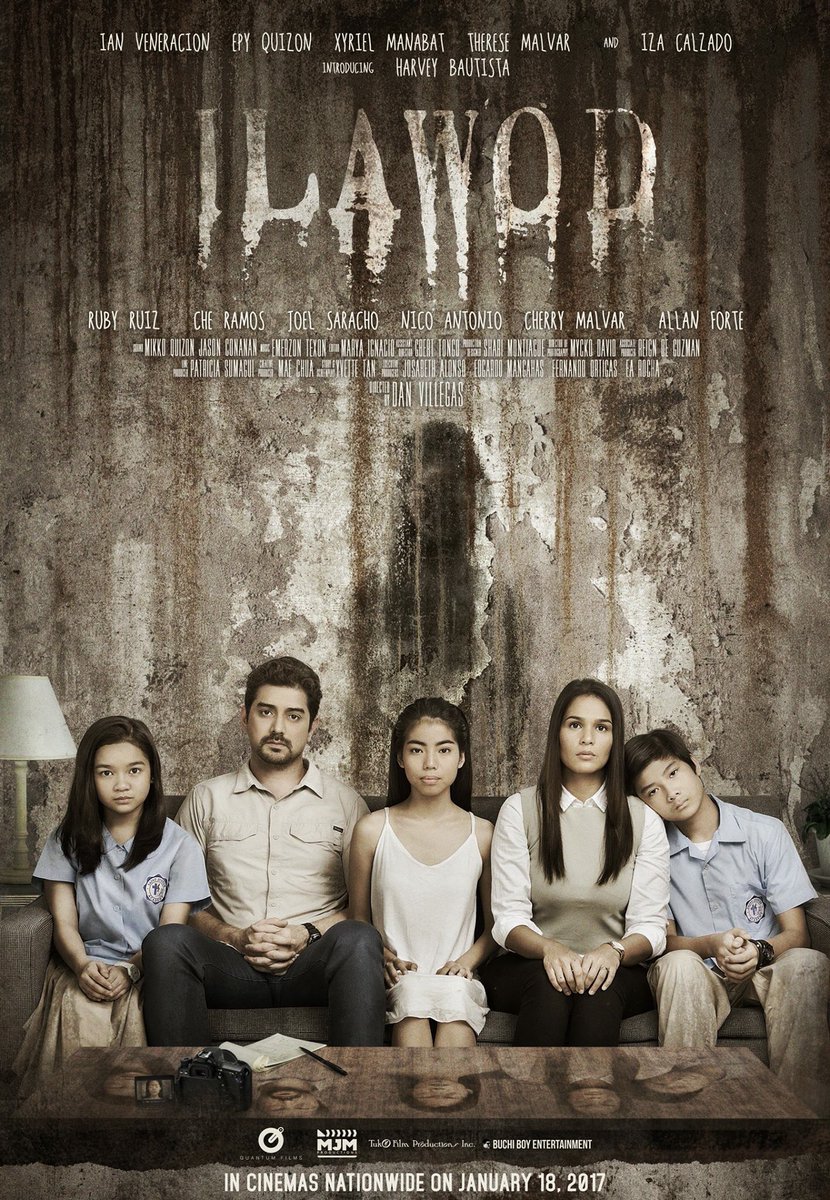
Triple Horror Reviews: Ilawod, Darkroom, Mang Kepweng Returns

After directing a slew of successful romcoms, Dan Villegas forays into the realm of horror with this latest offering. Ilawod on the surface seems like a conventional horror movie, it does touch on some interesting things along the way.

Its primary antagonist is a water elemental with a malevolent streak. Displaced from the rural setting that it is accustomed to, the titular Ilawod is thrust into the claustrophobic spaces of the city, where it terrorizes a modern Filipino family.

Whenever Asian Horror places its story in the context of family, the family often suffers from a certain kind of dysfunction. For example, Hideo Nakata's Dark Water (2001), which coincidentally also features a water spirit, stars a single mother and her daughter; single mothers are also the subject of Nakata's seminal film Ring (1998), and a broken family is the cause of the titular Grudge (2003, among others).

In this case, however, the family doesn't really seem to have problems on the surface: it looks like a perfectly normal, complete family. What the Ilawod does in this context is amplify the family's own personal neuroses, with the only exception of the youngest, most innocent member of the family. There's a backstory to the family in Ilawod that we only get glimpses of; and the entity uses that to her advantage.

The Ilawod herself exudes a very feminine vibe - and throughout the movie the male characters are unable to stop her or are unable to resist her temptations. The most anyone could do in the movie to stop the Ilawod is to drive it away temporarily. This proves to be a large source of problems for the head of the family (played by Ian Veneracion,) whose pride becomes folly*. If you go with this particular interpretation, it's a challenge to the role of the male or father in today's society: just as much as folktales change and evolve from past to present, so does the definition of 'family'.

While the horror aspect of the movie plays it rather safe, there's a lot in the execution of Ilawod that makes it a noteworthy local horror film and a promising start to 2017.

* then again, had Ian Veneracion's character swallowed his pride instead, there's no indication there would be any difference in the ending. But that's kind of missing the point that his authority as father and head of the family is severely undermined by the presence of the Ilawod.

Darkroom combines teen horror with found footage, perhaps one of the first of its kind in the country. It's directed by Pedring Lopez, who helmed 2015's Nilalang, a film that, despite its shortcomings, had a lot of imagination behind it.

The film begins with an exorcism that ends rather abruptly (is it a coincidence it was filmed a day before the EDSA revolution? In some interpretations of the film, perhaps not.) We then see a number of teens preparing for a visit to said house in the present day, fulfilling all sorts of horror cliches.

The first half of the film is rather mundane as the teens go about their respective activities. It's all boring on the surface. But if you look behind the lines, there's something different lurking behind the surface. As we know, inevitably, these people will meet grisly ends, the high point of most horror films of this subgenre. As such, this first half is self reflection on the sheer vapidity of some of these characters.

Found footage is a genre that really works within the selfie-obsessed, instagram-taking generation that these characters embody. These characters are concerned mostly about themselves. These are the sorts of kids that take selfies on Holocaust memorials, ignorant of the meaning behind the place. They ignore the atrocities of the past, thinking that these atrocities are of no consequence to them. Of course, that's hardly the case. As such, Darkroom can be viewed as a subtle critique of our current generation.

Once things get going (sadly, not for long enough) things get entertaining. There's a lot of blood and gore to satisfy a good number of horror fans, and although some of the horror moments aren't as effective as others, they're decent enough. (Bret Jackson being an excellent screamer with fantastic eyelashes really helps.) On the other hand, some scenes are a bit silly, and other scenes would have benefited more from implying rather than showing (something that found footage can do well.)

Darkroom is not perfect, but its a laudable first effort for the genre in local cinema.

pictured: probably a better movie.
Though it's more of a horror comedy (and the actual nature of the movie is even more of a mess than descriptions can allow), Mang Kepweng Returns will earn a place here for rather arbitrary reasons.

There's a scene in Mang Kepweng Returns that juxtaposes a funeral with gaudy spectacle. It's a joke that has a weird tone and isn't really funny. That's basically what this movie is in a nutshell.

The movie is based on a comic strip by Al Magat, who spawned two movie adaptations, Mang Kepweng (1979) and Mang Kepweng and Son (pictured, 1983) starring the late Chiquito. The original series is about the adventures and misadventures of a local faith healer, or albularyo, mixing comedy with supernatural elements. Admittedly I'm not a big fan of the brand of comedy in the original two films. It's the kind of "tito" humor that I kind of laugh along with during family get-togethers but would otherwise dismiss, but in the end I really don't mind either way.

Having said that, Mang Kepweng Returns takes this and applies the old MMFF formula to it - and by old MMFF I mean the braindead, pandering nonsense of MMFFs past. It comes as no surprise that this film was submitted to this year's MMFF and (rightly so, in my opinion,) rejected. Mang Kepweng Returns can be considered as spiritual sequel of sorts, where Mang Kepweng's son (also named Kepweng) inherits his father's bandana, the source of most of his powers.

The film doesn't really do a good job communicating this story. For one, the camerawork doesn't really suit the movie at all - it's a bit subtle, but the low angles, darkened lighting and at times handheld shots make this seem more like a gritty indie movie that a commercial horror comedy. The tone is a complete mess, and you really can't tell whether the film is taking things seriously or if everything's a joke. Seemingly important characters are put on a bus near the halfway point, only to reappear after a while for no reason.

The special effects range from not very good to halfway decent, including a computer generated original Mang Kepweng that reminds me of what ILM did with Rogue One, albeit with (probably) the budget of a few coins, some lint, and a bag of wet noodles. The film also makes references to the Chiquito adaptations, even getting a few jokes here and there, as well as from Chiquito's other films: for example, one scene in particular is almost lifted straight from Chiquito's Estong Tutong (1983).

Mang Kepweng is a faith healer, yet the film treats him as more of a comic book superhero, which doesn't really suit him as a character. The ending scene where Kepweng fights a number of supernatural creatures in a boring fight scene seems to hammer down this point.

Mang Kepweng Returns is a frankenstein's monster of a movie that needs to be put down for its own good. It's the type of MMFF film that should have died years ago, but keeps on shambling like a zombie long after its insides have rotted away.

Thursday, January 12, 2017

Short Reviews Jan 2017: La La Land, Labs Kita, Okey Ka Lang?

Even from the very start of Damien Chazelle's La La Land, where a number of characters execute a sublimely choreographed number on the Los Angeles freeway, I knew I was in for a treat. Its first half, a whirlwind romance between two struggling artists, evokes images of Hollywood Musicals of ages past. It's a treatment Chazelle has tried before with his first film, Guy and Madeline on a Park Bench, recontextualizing the grand MGM musical into something grounded and contemporary.

These setpieces are staged with considerable panache, using clever blocking and camera movement to capture that old timey feel. Some setpieces are admittedly more effective than others, but nevertheless the overall effect is quite gratifying. Perhaps this bravado stems from the lessons learned from Chazelle's second film, Whiplash, a technical wonder in its own right. And boy, when this film gets it right, it nails it on the head.

And yet, as much as this film is a loving tribute to Old Hollywood and the pursuit of fame and stardom, it's also a deconstruction. As we get to the halfway point in the film, we find that the characters are trapped in their own 'La La Lands,' where the fantasy, idealism and escapism of a 'Classic Hollywood' plot gives way to pragmatism and a bit of cynicism as well. The questions it asks about the cost of living your dream mirrors his other films, but approaches the subject in different ways. The end result can be magical and profound, yet bittersweet at the same time. The film's final sequence, heartbreaking and exhilarating at the same time, contains the unadulterated exuberance that I sorely missed from Whiplash. And just for that, this film is one for the books.

As part of ABS-CBN's continued effort to remaster and restore their large collection of films, the UP Town Center is holding a retrospective of some of their classic films from January 11-15. One of the newly restored films in their collection is the 1998 film Labs Kita, Okey Ka Lang? starring the formidable duo of  Jolina Magdangal and Marvin Agustin.

Bujoy (Magdangal) and Ned (Agustin) have been friends since childhood. They obviously have feelings for each other but are unable to express said feelings. Eventually, they play matchmaker with each other, pairing the other with another person, in what has to be the highest level of friendzone I have ever seen.

It's interesting to see the Star Cinema Rom Com (tm?) in an earlier stage of its evolution, before the rise of hugot and other modern conventions of the form.  But even so, most of the recognizable traits of the formula are in place: both have their respective sidekicks, there's a dramatic turn in the final third of the film that brings about conflict, and the film ends with a dramatic chase scene and a relatively happy ending. While it's pretty much by the numbers, it's fun seeing actors as they were in the nineties before they moved on to headlining their own movies, such as Vhong Navarro and Meryll Soriano. There's also a nice (unintentional?) throwback to another romantic movie set in Baguio, Kung Mangarap Ka't Magising, whose star Hilda Koronel has a supporting role in this movie.

Watching the film gave me a sense of nostalgia for the nineties and my own teenage years. And although she isn't as active in showbiz anymore, it's undeniable that Jolina Magdangal has a significant impact on Filipino pop culture. I enjoyed Labs Kita, Okey Ka Lang? despite its faults, and it will probably be a source of quotable quotes for years to come.

Thursday, December 29, 2016

Present Confusion 2016 Rundown!

2016 IN A NUTSHELL
The end of the world year is upon us, and for a lot of people, 2016 can go fuck itself. For better or worse, 2016 was a year of change, not only in the film industry, but also the world. It will probably be a while before we see the lasting effects of this year on civilization as a whole, but until then, we keep on moving on, because that's probably the only thing we can do right now.

In lieu of the usual listicle I will be doing this best-of list in consolidated paragraphs instead. My choices will be highlighted in bold. Of course the usual subjectivity disclaimer applies, and if your film doesn't appear in my list, sucks to be you. (Just kidding, of course.)

Philippine Cinema Favorites in 2016: Shifting Paradigms

2016 in Philippine Cinema was an interesting year. From 2015, which has a number of really outstanding films, there were a lot of really good films in 2016, but not a lot of great films. As the year was nearing its final months I was still struggling to find a local film that really caught my attention. In the end I name six films that I really found notable this year. In no particular order, here they are.

The old stalwart of "indie" film fests, Cinemalaya, came back this year with a lineup of feature films, but most of the films felt safe. Even the shorts section, which usually offers a level of experimentation not seen in the feature films lacked this property. It's understandable for a festival that's testing the waters after a year of hibernation. The extra preparation time may have resulted in a less troublesome resource gathering process, but in terms of the movies' overall quality, the difference in output is quite negligible.

Out of Cinemalaya comes my first selection, Pamilya Ordinaryo, whose premise fits very much within what I usually expect with Cinemalaya. It shows us how even the most ordinary of families ends up exploited by entities higher up in the societal food chain. But it's so well done, it's hard not to give it some credit. If there's one thing that Cinemalaya can boast this year, it's a range of really outstanding lead performances, male or female. In this case, it's Ronwaldo Martin and Hasmine Killip who deliver the goods.

Speaking of great performances, there was one performance in particular that won praise in festivals abroad:  Jacklyn Jose in Brillante Mendoza's Ma'Rosa. Mendoza goes back to the social realist film that he does best, adding in a tinge of relevancy for good measure. However, like I said before, Ma'Rosa is not simply a film about the drug trade - it's about the economy of corruption that has taken root in our society, where lives and people become commodities.

And many films this year tackle deeply rooted societal cancers. Most notable in this subset of movies is Sheron Dayoc's Women of the Weeping River, about the trappings of deep seated mentalities and traditions that prove self destructive towards everyone involved. It's a deeply nuanced portrait of what happens with my brothers and sisters in the south, made even more relevant for me because, as a Muslim Filipino myself, this is a personal story as well.

Some societal cancers go away and are excised, but in my line of work, cancer tends to recur and metastasize - the internment of a certain dictator is evidence of that. People tend to forget quite easily, it seems, perhaps because hardship never touched them directly or they were favored in some way, or because of ignorance. On the other hand, there are people who remember, like the victims in Teng Mangansakan's Forbidden Memory. These days films like this are necessary, because unless we commit these memories to posterity, forces that seek to revise history to their own ends will succeed.

False messiahs like Marcos are actually quite abundant, preying on the gullibility of people and their propensity to seek hope. Another film that tackled this notion is one of three films released by Lav Diaz this year, Hele sa Hiwagang Hapis. Though his later film, Ang Babaeng Humayo, received the more prestigious prize, anad as far as Diaz's films go, this is not his best, I found myself gravitating towards Hele a bit more, because of the way it was made specifically for a local audience. There's something poetic in this film which his other two films do not have.

Let's move away from the doom and gloom of the year and move on to something a bit more positive. Film festivals in the Philippines came and went this year. Cinefilipino, Sinag Maynila and the FDCP's own World Premieres Film Festival had their share of films, but none of the films from their lineups really made me pay attention. QCinema continued with a quality lineup, but I found myself preferring last year's edition a bit more. This year's Cinema One film fest is probably this year's most adventurous, playing with different genres (and completely defying expectations of what a documentary should be.) Even then, I found myself wanting.

But surprisingly, (even shockingly) it is the revamped Metro Manila Film Festival, under the helm of the new FDCP, that really surprised me. I guess it's also partially due to low expectations coming in. The MMFF still has a long way to go, and issues from past iterations of the MMFF with respect to financial transparency need to be looked into, but at the very least, I think this is a step forward.

My favorite film from the fest (still ongoing, by the way,) is Baby Ruth Villarama's Sunday Beauty Queen. This film, along with Forbidden Memory, is part of one of 2016's triumphs - that of the documentary form, which is slowly emerging from under the shadow of its fictional narrative brothers. Sunday Beauty Queen is a celebration of the Filipino spirit, and an acknowledgement of the tragedy behind it, because these people have sacrificed a lot for the sake of their families.

Philippine Cinema Favorites in 2016: Honorable Mentions and Misfires

'Good, but not great' defined most of my year as far as local films are concerned. But of course tastes are subjective, and this year really gave us some gems. Here are the films that rank among my honorable mentions for 2016 (perhaps representing the lower 2/3 of a top 20 list if you look at it that way.)

Some of this year's noteworthy films are just plain gorgeous to look at, and I saw two differing aesthetics with regards to cinematography and production design. The first is large, picturesque views of the Philippines, perhaps best personified by Ice Idanan's Sakaling Hindi Makarating and Bagane Fiola's Baboy Halas. The second, beautifully shot, intimate frames of the spaces we live in, exemplified by Prime Cruz's Ang Manananggal sa Unit 23B and Malay Javier's Every Room is a Planet.

Horror movies figured in some way in the local scene, most notably Erik Matti's latest Seklusyon, which continued his exploration of power and faith. Some films went for the cliches and failed, such as Gino Santos' Lila. Others played with the genre to create something completely unique, such as Keith Deligero's Lily. But the top prize has to go to, of all things, a short film: Eduardo Dayao's If You Leave. While it does touch on similar concepts to his earlier Violator, it does not make the finished product any less scary.

Speaking of shorts, there were a lot of interesting short films this year, and a lot of conventional fluff. My favorite is probably Fish out of Water, which talks about mixed children and their struggle to find a place in a society that tends to alienate them.

Gender issues had its share of the spotlight this year; however, at the same time, independent productions had their share of misses, such as Cinefilipino's Straight to the Heart. But this year had a gem in the form of MMFF's Die Beautiful, buoyed by Paolo Ballesteros's performance and Jun Lana's solid directorial hand. Even in mainstream productions, such issues were starting to reach the surface, seen in movies like Lana's Bakit Ang Lahat ng Guwapo may Boyfriend? and Jason Laxamana's The Third Party.

And it's a good 2016 for director Laxamana as we include in this list two movies that he was involved in. The first one, 2 Cool 2 Be 4Gotten, a collaboration with filmmaker Petersen Vargas, is wistful at times and shows mastery of the cinematic language (impressive for a first time filmmaker). The other, Mercury is Mine, is carried by an impressive performance by, of all people, Pokwang, and its story and themes have proven to be haunting long after seeing it. With productions both mainstream and independent under his belt this year he's on a bit of a roll.

Other notable films of the year include the clash of old and new, whether it be tied to something more mythopoetic, like Derrick Cabrido's Tuos, or to something a bit more grounded, such as ToFarm Film Festival's Paglipay. From this subset of films comes a real gem from Alvin Yapan's Oro, perhaps his best since Ang Sayaw ng Dalawang Kaliwang Paa, whose social injustices are rooted in real and tragic events.

Other films are notable to me for just one particular aspect. In a world where films based on medicine end up horribly inaccurate (even those from Hollywood), Vilma Santos starrer Everything About Her ends up as one of this year's best researched films, foreign or local, in terms of medical care. For the unique way it presented itself visually, I found Cinefilipino's Buhay Habangbuhay immensely interesting.

Philippine Cinema 2016: The Weakest Links

I find myself generally charitable towards local films, even the really bad ones. I also almost never walk out of movies because I know I want to give it a chance. But this year one really bad stinker got me. It's the first and only time this year I've walked out of a film. The distinction goes to the three hour director's cut of Ligaw. It's the kind of film that denies you any sort of satisfaction. I left the theater ragged and tired as hell.

But that's not the only film that tired me out this year. I prayed that Gil Portes' Ang Hapis at Himagsik ni Hermano Puli would be good even in some minor way. In this case, God didn't listen to my prayers. My friends who were with me during the Cinemalaya premiere slept through most of the film, and I think they were the lucky ones. At least I found this movie hilarious, in all the wrong ways.

To complete the trifecta of badness, we go to the most entertaining entry in this year's worst list: Enteng Kabisote 10 and the Abangers. I admit being entertained by this film, but only through interpreting it as a self reflexive criticism of itself. It is the embodiment of the commercialism and decay that the film industry has gone through, commodifying cheap distraction for money.

There's a large number of films that I wish I could have seen this year such as Upline Downline, but alas, those things disappear quite easily.

Speaking of things that are funny, let's speak about jokes that are not funny at all. The most unfunny joke of 2016 in Philippine Cinema goes to the FAMAS awards, which, as an award giving body has lost all of its credibility (to be fair, this might have happened a long time ago.) To give one glaring example, this is an awards giving body that gave this year's best special effects award to Angela Markado a film whose special effects would be bad even in 1995:

this is the FAMAS best special effects winner. You daft bastards

That's it for local cinema. This time it's time for the rest of the world.

Rest of the World: The Hollywood Capitalist Machine

Meanwhile, in Hollywood, executives and corporations polished their latest finely tuned product to consumer perfection. No genre has filled our consciousnesses more in the past decade or so than the superhero genre, and it's Disney (tm) Marvel (tm)'s Captain America: Civil War that wins my favorite superhero film of the year. It's fun, it's exciting, its a wild ride, if not a bit safe.

On the other side of the fence, Warner Brothers was trying to copy this formula to rather disastrous results. I did not enjoy Batman v Superman at all (the extended cut was a bit better) and although I liked Suicide Squad, its tone was more schizophrenic than its most deranged characters.

It's not a problem just inherent with Warner Brothers. Remakes, reboots and sequels all got shafted hard this year, from Ghostbusters to Independence Day: Resurgence. All in all, 2016 was a pretty shitty time to be a big blockbuster franchise film.

One franchise celebrated its 50th anniversary with a whimper this year: Star Trek, my most beloved science fiction franchise. Star Trek Beyond is not a bad movie in any sense, but the marketing that accompanied this movie was almost non-existent at points, leaving a disappointing box office take. It still remains my favorite of the reboot films.

We end this year with Rogue One: A Star Wars Story, which is definitely enjoyable, but shows me the cracks that are forming with Hollywood and its blockbusters. So many of these films depend on intertextuality so much that without the intertextual reference, the movie falls apart - and that's what I see with Rogue One, which would not have worked even half as well without A New Hope. While it gets a pass thanks to the way it complements A New Hope, its a dangerous precedent for films to come in the future.

Hollywood has brought out some interesting original content this year, mostly during the Oscar season. Examples of this for 2016 include Lenny Abrahamson's Room, and Spotlight, which eventually took the Academy Award for Best Picture.

In terms of animation,  Disney had competition from films like Kubo and the Two Strings, which is a phenomenal achievement in animation, even though its story is very basic, My favorite Disney/Pixar film this year is Moana, a charming little film with progressive ideals, honed by years of prototype films in the same mold.

(as an aside Zootopia honestly did nothing for me don't kill me guyz)

Rest of the World: Asian and World Cinema
I really don't have the chops to tell you about World Cinema this year, as I haven't seen some of this year's best films in World Cinema, including Best Foreign Film winner Son of Saul, postcolonial narrative Embrace of the Serpent or any of the films Isabelle Huppert starred in this year.

I have seen a bunch of other films from around the world, mostly in Japan and Korea, so I guess I'll talk about those instead. I promise to watch more world cinema next year.

hehe.

Some really interesting foreign films seen during film festivals include Taiwanese drama The Kids, and from this year's Eiga Sai, Hirokazu Kore-eda's My Little Sister, as slice of life as you can get with these dramas, and 2014's Pale Moon, a dark look at capitalist excess in the bubble era of Japan's economy. But none have been as impactful for me as this year's Palm D'Or Winner, Ken Loach's I, Daniel Blake, whose issues have sparked discourse in its home country.

This year I had the privilege of seeing films abroad. Hollywood superhero films have a Japanese cousin - the manga adaptation - and my favorite manga adaptation was this year's Chihayafuru (parts 1 and 2,) which I saw in Tokyo last June. It's not completely faithful to the source material but it does have some interesting moments and a great performance from teen actress Suzu Hirose, who seems to be in demand right now.

Quite fortuitously, one of Suzu Hirose's other films finds a spot among my favorite films of 2016. While a lot of people may find the melodramatic last sequence of Lee Sang-il's Rage problematic, I though it was a nice end to an unforgettable, emotionally draining film, probably Lee's best since 2010's Akunin.

Genre films also had their day this year. For horror fanatics, The VVitch was an interesting watch and a phenomenal first film. Korea also had their own share of horror movies in top form, such as Na Hong-jin's The Wailing, as well as this year's runaway blockbuster Train to Busan, mixing both social relevance and good old zombie action.

Kaiju films had their heyday with Hideaki Anno's Godzilla Resurgence, which follows the 1985 and 1954 films in tone, reinventing Godzilla and the Kaiju genre for modern times.

Of course, as a fanboy of director Park Chan-wook, his latest, The Handmaiden, showed Park in a return to form, in what is probably my favorite film of his after the Vengeance Trilogy.

And finally, there's the rare film that I watch and I get this feeling of magic, and the sheer joy of watching movies fills me up. It's a feeling that I haven't felt in a long time, but this year I've been lucky to experience such a film once again in the form of Makoto Shinkai's Your Name. Given how it has demolished box office records in its home country, it might come off as a little overhyped, but in my opinion, not overrated. Your Name isn't just a good anime film, it's a great film, period, and its films like these that remind me why I love doing this shit so much.

Treasure the moment; Dreams fade away when you wake up.
Eleven years and counting, guys. Next year is going to be the centennial anniversary of Philippine Cinema and a new year for the cinema of the world. This is me, signing off for 2016, and as always, see you bastards at the movies.