rotban

Tuesday, June 23, 2015

Capsule Reviews and Stuff, June 12-23

Whew! It's been a crazy fun two weeks, mostly spent vacationing in the land of the rising sun. That unfortunately leaves less time to watch movies in lieu of sightseeing.

But, being Japan, what are the movies that are being shown over there right now?

Now Showing in Japan

There were a lot of anime adaptations showing in Japan at the time, including an adaptation of cycling anime Yowamushi Pedal. Mad Max was just on its way to theaters when we were there. Three movies in particular piqued my interest:


Two of the three movies are based on bestselling books. The first one, boasting a readership of 1.4 million readers, is Initiation Love, starring perennial favorite Shota Matsuda and AKB48 ace turned actress Atsuko Maeda. I saw this movie promoted heavily everywhere, and based on the trailer it has a bunch of crazy twists near the end.It's probably not your typical love story.

The next movie I'll be talking about is Biri Gal. It is based on the true story of Sayaka, a gyaru who is at the bottom of her class ("Biri" means at the bottom) who finds an inspirational teacher in Mr. Tsubota (Atsushi Ito) and aims to pass the entrance exams to Keio University, renowned for being one of the hardest universities to get into in Japan. I saw a feature on this real life story during a late night program, featuring the real life Sayaka and her mother and comparing her real life to the movie. It's one of those feel good inspirational movies you tend to see in Eiga Sai. (Probably next year. Heh.) 

And finally, we have Gokudo Daisensou (Great Yakuza War, also called Yakuza Apocalypse) about Yakuza Vampires. Let me repeat that. Yakuza. Vampires. Based on the trailer this is classic Japanese zaniness all around, which is an instant selling point for me. Hayato Ichihara seems to be cast repeatedly in tough guy roles. I'm still waiting for a return to the sensitive roles he had when he was starting out with All About Lily Chou Chou, but in this particular case, I don't really mind.

BECAUSE YAKUZA VAMPIRES. YOUR ARGUMENT IS INVALID.

Anyway, let's get on to movies I did watch in the past two or so weeks.

 Gashapon Capsule Reviews

A Jurassic Park movie and a Terminator movie in cinemas!? What decade is this?

The first Jurassic Park movie was a wondrous experience for myself and many other moviegoers in the nineties. It showed us the magic of CGI on an epic scale for the first time, it was an engaging story on the dangers of man playing god, and it had dinosaurs. The next two movies were just so so, and were ultimately forgettable.

More than 20 years later, the Jurassic Park franchise undergoes a soft reboot with Jurassic World, a sequel to the first film. While man's hubris in the first film was contained thanks to laser guided karma, this film has mankind overcoming the technical limitations of making a dinosaur theme park. This time, however, we one up ourselves by trying to make a horrible dinosaur hybrid that predictably breaks loose and wreaks havoc on our protagonists.

Man vs. Nature comes into full swing here, but in a way the film also criticizes our overly materialistic spirit of always wanting more. In a related way, the film self-reflects on the state of the blockbuster film as we know it: in the years in between the first Jurassic Park and this one, we have escalated our endless hunger for always wanting more exciting films, more loud spectacles, to the point that every new chaotic, cacophonic creation is more numbing than inspiring. The Michael Bay manufactured products and the nostalgia-exploiting flicks of the past decade are the Indominus rexes of the movie world. This movie may well be one of those films.

And thus, while it is an entertainingly worthwhile popcorn flick, there really is nothing new on the plate as far as this movie is concerned. The sense of wonder in the original film feels muted here, and while the references to Jurassic Park are appreciated, there's a feeling of playing things safe in this one.

(Also, I am a bit miffed at the fact that the dinosaurs do not reflect current scientific knowledge on what dinosaurs actually look like i.e. with feathers, which makes this a step backward in the whole  popularizing science angle.)

I'm not the biggest fan of Doraemon, but I'm well aware of its impact throughout Asia. I've seen a number of episodes and I love the comedy. For Stand by Me Doraemon, the latest in a line of the franchise's cinematic features, the series makes a ballsy move to 3D CGI. While the Japanese are known as masters of 2D animation, their reputation in 3D CGI is not as impressive, with only a handful of titles matching the quality of animation of their western neighbors.

Surprisingly, Stand By Me Doraemon manages to look really good as a 3D film, and as a film in itself, it's an affecting and touching emotional roller coaster ride that is guaranteed to get a laugh and bring a tear to one's eye at the same time.

The film consolidates and condenses several story arcs from the manga/anime to create a self contained story that anyone can appreciate even though he or she has seen little to none of the original manga or anime, starting from how Doraemon and Nobita met to various adventures. This movie emphasizes the friendship between the two characters and how they influenced each other over their many hijinks together.

The CGI is very well made, mixed with miniature animation making the whole thing feel even more realistic at times. It's a marvel seeing this kind of animation compared to animation produced ten years ago that looked really rudimentary - Japan's CGI animation techniques have evolved.

The film is quite serious at times, and I was surprised to see myself tearing up at some points in the film. I'm guessing the effect is enhanced if you're a fan of the film. The movie was dubbed in English for local release and the voice cast sounds fine compared to the original Japanese dub.

I want to see this film be appreciated more than it already is. It's one of the best movies to come out this week, whether you're a fan of the franchise or not.

Wednesday, June 10, 2015

Take Me Out to Akiba

Picture taken by me. Yes I am a cartoon blimp flying in the sky.

Tokyo's Akihabara district (often shortened to Akiba) is a haven of electronic goods, manga and anime merchandise.Whenever I go to Japan I make it a point to drop by. The experience is almost a pilgrimage of sorts for me. At the very least, it is a trip I look forward to every time I go back to Japan.

Today I'll be talking about media set in and referring to the fabled district. For once, I won't be completely talking about movies as I'll try including TV shows and other types of media.

When one mentions Akiba, the place is nearly synonymous to otaku and otaku culture; surprisingly, although there are anime that feature otaku and otaku culture such as Otaku no Video and Genshiken, very few take place primarily in the district itself. There is the rather forgettable Cyber Team in Akihabara which is not really worth talking about. The rest have short scenes in Akiba here and there, such as this season's Denpa Kyoushi, which is best described as GTO with an otaku teacher.

Tokusatsu, has one up on the anime genre, as Toei has made an (albeit unofficial) installment of their Super Sentai series centered on Akiba. Unofficial Sentai Akibaranger is a series parodying the Tokusatsu genre and many of its tropes. Other than that, the series focuses on that rather than the setting, mostly being a different kind of love letter to the Super Sentai series as compared to Gokaiger, which aired close to Akibaranger's first season.

Man.. this is off to a good start. I am being sarcaaaaaaaastic.

Anyway, thank the great bird for video games, because they released something that I can legitimately talk about!

Akiba's Trip: Undead and Undressed is a game released for the PS3, the PS Vita and the PS4. It's a sequel to a (AFAIK, Japan-only) PSP game called Akiba's Trip. From the guys who made Way of the Samurai, one of my favorite games of all time, Akiba's Trip (get it?) is a game where you run around Akihabara and strip people of their clothes. That's right. There's a reason for all the indiscriminate stripping, as most of the people you will be stripping are vampires, and removing their clothes will expose them to more sunlight, allowing them to burn under the sun.

The game is structured in the same New Game + play structure where you collect items and complete different story paths every time you go through the game (the game itself can be finished in around ten hours or less). This structure can also be seen in the aforementioned Way of the Samurai, as well as the rather niche PSP game Kenka Bancho, whose game engine is very similar.

What about Akiba, you ask? Akiba's Trip has one of the most accurate depictions of the district in any non-film media, ever. Aside from changes to a few place names (UDX becomes UD+, for example), the layout of the place and the detail is uncanny. Most store facades are as you would see them in Akiba in real life. 

It's decidedly not for everyone, but for fans of the genre it's a treat. I personally enjoyed it both as a fan and in appreciation of the great job they did recreating the setting.

In terms of movie depictions, Akihabara tends to get left by the wayside compared to its more popular and mainstream siblings Shibuya and Shinjuku. That doesn't mean it's completely absent;the district shows up every so often in film featuring otaku and otaku culture. One movie of note is the wildly popular Densha Otoko (Train Man,) which is based on a bunch of posts from the giant image board 2ch. In itself Densha Otoko deserves a whole entry, as it spans a novel, several manga series, and a live action television series in addition to the movie, but we'll leave that story for another day.

Now for something of a somber note. In 2008, a man drove a truck into a crowd in Akihabara, then proceeded to randomly stab a number of people in the vicinity. He was captured, tried and executed, but there were a lot of changes to the way the street opened up on weekends, changes that I felt as far as 2012, when I first visited the district.

There have been two films made about the massacre. One is titled Botchan, which is a loose adaptation and feels more like a black comedy focusing on the perpetrator (little of the film actually takes place in Akiba). The other one, which we will be talking about today, may be the most immersive of all the media we  have talked about today. The movie in question, pictured above, is titled River. The movie is about a woman (Misako Renbutsu) who lost a loved one during the Akihabara incident. She returns to the district and talks to a number of people on how they managed to recover (or not) after the incident.

River was directed by Ryuichi Hiroki, who is probably best known for directing the 2003 adaptation Vibrator. River is a somber, silent contemplation on the effects of tragedy and the process of moving on. By some stroke of fate, one of Japan's most tragic disasters happened during the shooting of this film: the 2011 earthquake and tsunami that claimed thousands of lives. As such, scenes from the devastation, probably only weeks from the actual event, were inserted in the film, in one long take that mirrors the beginning of the film. I can only wonder what Japanese audiences thought when they first saw the scope of the devastation on a personal level.

I've seen the Japanese use film and media to help their collective psyche recover from tragedy - I often think of films like Godzilla and manga like Barefoot Gen as a response to the bombs dropped in Hiroshima and Nagasaki and the subsequent atomic era. As for what happened in 2011, the spate of films coming out afterwards perhaps reflects a need for the collective consciousness to experience the pain as a means of reaching past it.

On to something else then. Until next time.

Sunday, May 24, 2015

Capsule Reviews May 12-20

Before I start talking about Maggie, take a look at that poster that was used for the Philippine release. It looks like Arnie is gonna mow down some zombies ala Terminator. This is definitely not the case.
The aim of the (good) zombie movie is to reveal something about the human condition. Maggie one ups this and frames the story as a human drama. Arnold Schwarzenegger is a dad facing the imminent zombification of his daughter Maggie. We see the repercussions of this process and how it affects Maggie, her family and friends.


This descent into the realm of the living dead is treated with a modicum of grace. It doesn't try to sensationalize the concept, nor does it try to overly pull on your heartstrings - although heartstrings will definitely be pulled. It serves as a fresh take on the zombie genre that one wonders why it hasn't been done like this before.

It is a bit slow paced, and the dreary atmosphere alternately helps and doesn't help, but in a movie about losing humanity, Maggie has lots of it. It's also Schwarzenegger's finest performance to date.


Taking place between chapters 699 and 700 of the manga series, The Last: Naruto the Movie is probably the franchise's most canon movie outing ever. While it tells the story of the end of the world an digs deep into the vast mythology of Naruto's ninja world, at its heart the story is about how Naruto and his longtime admirer/friend Hinata got hooked up. It's basically a ninja How I Met Your Mother.

Fans of the pairing may rejoice at the amount of screentime the two characters get, but other fans may be left wanting. Fans of the Sasuke/Sakura pairing, on one hand, may be left a little disappointed as Sasuke is reduced to nothing but a cameo. (The recent Gaiden manga series may help rectify this and clarify a few more things regarding the timeskip between chapters 699 and 700.) The rest of the supporting characters get a little screentime, but otherwise they are relegated to the background. This is Naruto and Hinata's movie.

The Last is best viewed after having seen the anime or manga (the anime is slightly more recommended because of some anime only scenes between Naruto and Hinata that Studio Pierrot inserted for character development's sake.) The Last can be viewed as a culmination of all that character tension and buildup for 700 chapters/who knows how many anime episodes.

Masashi Kishimoto wrote the story for The Last, and as with the other feature he was heavily involved in (Road to Ninja, my most favorite Naruto animated feature,) this is a very personal story which emphasizes character development over the filler action we've been used to seeing in other Naruto movies. The thing is, it is best viewed after having invested your time heavily in the series or manga. Newcomers might find the movie confusing (or overly simplistic) otherwise.

Para sa Hopeless Romantic (For Hopeless Romantics) is nothing special in the greater scheme of things, but it serves as JaDine's most capable vehicle yet. Gone are the over the top anime-ish stylings of Diary ng Panget or Talk Back and You're Dead, instead we see a bitter Nadine Lustre still hurting after a disastrous high school romance. She pours out her angst in a story within a story (titled Bag and Folder, which is probably the worst title for anything ever) where SPOILER ALERT the two leads don't have a happy ending.

But like many other cookie cutter romances, Para sa Hopeless Romantic returns to the kilig status quo by the end of the movie - which, for fans of the love teams in the film, is not an entirely bad thing. For outsiders like some of us, it makes the entire ordeal skippable. While we see  the leads fall in love, the character development ends up shallow. The problem with kilig moments is that they are only worth that kilig moment. It really doesn't add a lot to how the romance is built up.

It is refreshing to see James Reid playing something other than the character types seen in his previous JaDine movies.  It is kind of weird seeing many of the actors in the film with bronzer or whatever kind of tanning makeup they had. I guess it's because it's a summer movie. And even in 2015, the stern old maid teacher stereotype still exists. Oh well. 

If you're a JaDine fan, you're in luck; this is probably their best vehicle yet. If not, then you really should watch something else.

The last time a director returned to a franchise after many, many years, the results were not as impressive as I had hoped. *coughGeorgeLucascough*

So when I learned  that George Miller was going back to Mad Max after thirty years, I was a bit skeptical. Thank goodness I was dead wrong - Mad Max Fury Road is the epitome of action spectacle, and one of the finest action movies in the past fifteen years. It's a bitchslap to all the action  directors of today and a tutorial of sorts on how to make an engaging, exciting piece of cinema without selling your soul to CGI and what I call action induced ennui.

The film succeeds thanks to its well choreographed stunts, its insane attention to detail and its seamless meld of practical and computer generated effects. It also helps by having two strong leads in the form of Tom Hardy's Max Rockatansky and Charlize Theron's Imperator Furiosa.

The film is rounded out by an absolutely kickass soundtrack (FLAMETHROWER GUITAR HOOOOOOOOOOOOOOO) a well written, suspenseful script and otherwise technically proficient filmmaking.

Mad Max movies are twisted metal fairy tales, and they let us see this post apocalyptic landscape through Max's eyes, almost as if it is saying that if we were living in this world, we'd go bonkers too. I'd personally want to be the Flamethrower Guitarist. I'm calling dibs on that now.

Tuesday, May 12, 2015

Random April-May Thoughts and Capsule Reviews

This entry is going to be more stream of consciousness than anything else.

***

Ai Hashimoto would make a good kuudere*. This cute nineteen year old actress has been appearing in a lot of interesting movies, and she has the whole kuudere look down pat.

Whether she's obsessing over an asshole in 2010's Confessions, acting in 2012's adaptation of Another (pictured left) or scaring people to death in the new Sadako 3D franchise, she is getting a lot of people's attention.

In promotional gigs you rarely see this person smile. She's like the Japanese Kirsten Stewart, only less smiley. 

One particular film I've seen recently that has Ai Hashimoto is 2012's The Kirishima Thing, where she is a supporting character. The film is basically a school drama and a take on the often complex social structures of (Japanese) high school with all its cliques and hierarchical structures. The increased importance of clubs in Japanese high schools also affects this structure. Many Japanese kids have a club during their middle and high school years, often devoting much of their off time in the singular pursuit of their particular club interest. (Of course, there are students who would rather do nothing at all - the "go home club.")

The message of the film is reflected in the Japanese Title, Kirishima, Bukkatsu Yamerutteryo - an exhortation from the oft pervading yet invisible Kirishima to quit clubs (and just live life.) His presence (or lack thereof) is felt throughout the film, and his one definite action quietly, but definitively, tips the hierarchy of the students in the school out of balance.

It takes the subject and treats it with the kind of silent contemplation Japanese films are wont to do. It also frames a film within a film - a zombie movie being made by the lower caste movie club - and we see how the two are thematically not that different. Zombie movies in the vein of Romero, most strikingly his 1978 opus Dawn of the Dead, operate with the spirit of subverting the carefully created social structures of humankind via an apocalyptic scenario. Zombies care not about seniority or whether you were popular or captain of the baseball team - they just want your brains.

The Kirishima Thing is the best kind of film, one that manages to stick with you and haunt you long after you've watched it. Also, it has Ai Hashimoto -the archetypal Kuudere- in it.

* from Urban Dictionary: An anime/manga slang term for a character that is cold, blunt, cynical, and pretty much doesn't care if her beloved dies. That's what she is on the outside but she is actually caring and nice on the inside. Differs from tsundere since tsundere is when the character frequently runs hot and cold between tsun and dere. Kuudere is when the character only occasionally shows her caring side.

***

South Park is one of my favorite shows. It almost never fails to show us a stupid aspect of humanity, amplify it to a factor of 9000, and show us how silly some things are.

I recently rewatched season 14 of the show and found a few really good episodes. I'd like to talk about the Tale of Scrotie McBoogerballs, where the four South Park kids, disillusioned from reading Catcher in the Rye, attempt to write the grossest, most subversive book in existence.

They succeed.

What hits me about this episode is how much it jives with what I see in criticism these days. Whether it's for movies, literature or something else, everyone seems to look too much into a piece of art, even though sometimes a spade is really just a spade. They start projecting their own ideals and beliefs and see that work of art either as something endorsing or condemning their own belief, even though the work of art just wanted to say the curtains are blue. 

Just because something is subversive and edgy doesn't make it good  either. Just saying.

***

I managed to see the horror movie Unfriended in a very cozy Resorts World cinema on a slow Friday (there were less than ten other people in the cinema with me). As far as horror movies go it's quite pedestrian - the basic plot, stripped of all pretense, is a by-the-numbers slasher plot. It is imaginative in the way it presents its story - entirely through the computer screen of our protagonist.

This method is not new - a 2013 Canadian short film beat it to the punch - but in the context of horror, it's  a fresh storytelling concept and it really manages to convey emotion and suspense even through very innocuous actions, such as a moment's hesitation over the send button, or retyping a message to prevent conveying sensitive information.

The theme follows various other contemporary movies of the internet age where ghosts and evil spirits wreak havoc using modern technology. Movies like One Missed Call and Phone used cellphones, Kairo (Pulse) used the internet, and movies like the Ring used video storage media.

The scares are quite effective, but they lose their steam after a few repeat watches. What is more terrifying to some (and to myself) is the fact that these teenagers are apathetic assholes who lack basic empathy. That scares the shit out of me because the notion of one of these teens bullying my future son or daughter is far more plausible than some malevolent entity trolling me through Skype.

It's fun but ultimately forgettable, and in a few years the technology will become dated and/or obsolete anyway. It will probably end up a gateway to other similar films, but unless they do something fresh with the next one, I predict the novelty of the presentation will soon fizzle out.

***

 I was going to make a retrospective of some Salman Khan films, just like what I did with Jr. NTR a while back. He has his share of serious films, but at the same time he is in a lot of mass entertainers. (I am a sucker for Indian mass entertainers.)  While he kinda had a slow phase mid decade, his films starting with 2009's Wanted are all very entertaining. Amongst the Khans (himself, Aamir Khan and SRK) he seems to have the highest appeal among the masses.

Also let it be said if there was a movie where Chulbul Pandey and Bajirao Singham team up to fight bad guys, I would totally lose my shit.

So imagine my surprise when suddenly I was met with this turn of events.

Salman Khan got sentenced to five years in prison a few days ago for negligent driving. 13 years ago, Khan allegedly ran over a number of people sleeping on the sidewalk, killing one. Khan denies the allegations, but the courts ruled otherwise. He is currently out on bail.

India is divided over the issue, with some saying that Khan's conviction was deserved and that no one is above the law, while some believe that deep inside he is a good guy and deserves some clemency. At the very least I wonder if the family ever got compensated for their loss. Financial support after losing their breadwinner really matters a lot too.

I don't know enough of the specifics of the case to form my own opinion on the case itself. I just hope that the court makes their decision while separating Salman Khan the persona from Salman Khan the person. Or, to put it in another way, separating Salman Khan the movie star icon from Salman Khan the man.

***

It's been a week since Floyd Mayweather won that megafight I had referred to in my Pacquiao retrospective. The moment I saw his style in the ring I knew the People's Champ was in trouble. While everyone was cheering on in the latter rounds, I was growing increasingly worried as my personal prediction of a Mayweather win by decision was coming true. I've gotten into a few fights, both real and in the domain of videogames. This was kind of chilling to see - one person was controlling the pace, putting the other guy out of his rhythm, gaming the system to win by points. I've done the same thing too, and most of the time it worked like a charm.

From my very limited perspective, Mayweather reminded me of one very particular fictional character in boxing - one that I think is quite unique. His name is Kenta Kobashi, and he's a character in the anime show Hajime no Ippo. Like Mayweather, Kobashi used a very defensive style of boxing, clinching and occasionally jabbing to keep the opponent of his rhythm. While far inferior in fighting skill to other boxers in the series, Kobashi knew how to box, and he was one of Ippo's most dangerous early opponents. He lost only because he abandoned his strategy to try to win by an infight - not a very wise decision. (He later went on to become the freaking Featherweight Champion.)

Kobashi's style was boring, but it won fights. It's not Mayweather's or Kobashi's fault that they were boring or seemed cowardly. It's the fault of boxing itself.

I'm no boxing expert, but in all of the fights I've seen in my life, something strange and different was definitely happening after the fight. Mayweather's performance was hailed as a 'master class,' a 'clinic' for staid, yet highly effective boxing. What Mayweather did in that fight was not easy - the man has unbelievable reflexes. Yet the crowd booed the champ out the stadium. For them, it really was a clinic. Sick people go to clinics, and in this case the patient was boxing.

To provide a bit of context, let me take you to a story about another sport - basketball. There are a few sports quite as exciting as basketball. Ever jumped up like a maniac and cheered after witnessing a buzzer beater? I have. I lived through the mythical Bulls era of the early to mid nineties. It was, and still is, riveting.

But way back in the fifties, Basketball was dying. Why? Games were getting overly defensive. Instead of the high scoring games we see now, players were content to slightly outscore the other team then (sometimes literally) sit on the ball and keep possession of it until the end of the game. Games became sluggish foul fests with many points being scored from the free throw line. Some games reached six overtime periods... and some ended with a final score of 19-18.

At the time, it was legal, and there was an element of strategy in it. It was defensive basketball taken to its limit. It was also boring as hell. People walked out of games and attendance fell like a rock. TV stations stopped airing games leading to a loss of revenue.

Then, someone invented the shot clock. It forced players to engage. It made players more athletic. It improved the game, and made the game exciting to watch. It literally made basketball the game it is today.

Back to the main topic. Boxing now? I think it's just like how basketball was back then. Instead of a sport where two people fight, we get a sport where two people try not to get hit. Imagine a championship bout where the two boxers have a style like Mayweather's. I'd probably fall asleep, and I'd have wasted my money from PPV to boot. Boxing pundits and "experts" might call it the greatest fight of the century. The layman, whose viewership is the lifeblood of spectator sports, would probably change the channel. There are other alternatives, like MMA, where fights are still what we want them to be: a fight.

Because you know, like that South Park episode, just like how sometimes a flower is just a flower,  sometimes a boring fight is simply just a boring fight.

I could be wrong, I admit. Perhaps instead of basketball, boxing will become something like soccer with all its intricacies and defensive strategies, where, like goals, punches thrown would be rare and be something to look forward to, where an intimate knowledge of the sport heightens one's appreciation of it. There's a reason why most of the world loves soccer, even though to some it looks boring to watch.

But if I am right, and we do not change the way we perceive boxing, or if boxing itself does not try to change like basketball did, there will be no more superfights, no 'thrillas' in Manila or rumbles in the jungle. The masterclass will have no students. The clinic will become a morgue.


That was four entries' worth of shit. Enjoy, and until next time, keep on truckin'.

Thursday, April 30, 2015

Avengers Assemble!


In comics, the crossover event is the once-every-few years thing that puts many comic book characters across multiple series into one big sprawling saga, one that usually changes the story arcs of the individual comic series for many years to come. It takes the already spectacular stories of comics and inflates them tenfold as characters that do not normally interact get to flex their muscles alongside one another, both literally and figuratively.

The Marvel Cinematic Universe is an ambitious effort to show several films featuring characters from the shared universe and establish continuity among all the movies. Actions in one movie have their repercussions felt in other movies. It's basically comic on film, and for Disney and Marvel Studios, it's proven to be a multi-billion dollar gamble that for the most part is paying off. For the MCU, their big crossover event is the Avengers. The first one, released in 2012, was a fun epic flick that bridged together several storylines and served as the origin story of a team of superheroes. It was, for all intents and purposes, the big-budget comic book blockbuster done right.

Following the traditional hero's journey type of storytelling, the second installment in the Avengers series, Avengers: Age of Ultron sees earth's mightiest superheroes in a period of transition: now that the team has been formed, it's time or the team to face their biggest challenge yet. In this case, it's Ultron, an artificial lifeform that has been a giant thorn on the Avengers side for ages in the comics. In the comics, Ultron has been so successful at times that he has managed to completely wipe out the team on a few occasions (most notably, the comics event Age of Ultron, whose storyline has no resemblance to the movie).

In this film, each member of the Avengers team reaches a crossroads regarding their role as superheroes and as members of the Avengers.Tony Stark tries to balance his good intentions, whose consequences may do more harm than good. Scarlet Witch and Hulk try to sort out their relationship (if this is even possible at this time) and face their own pasts. Hawkeye begins to look back at the things he's beginning to leave behind and see if it's all worth it. Thor faces a vision of annihilation and sees the responsibility he will bear in the battles to come. And finally, good old Captain America, fresh from his stint in the Winter Soldier arc, has his own issues and a conflict of ideologies with some of his other teammates (conflicts that may bear fruit in the next Captain America installment.)

Some members will stay and be changed, and some will inevitably leave. As much as this movie is about the Avengers finding their place as a team, it is also how these individual superheroes find themselves in the greater picture.

The  movie does its part to establish continuity. It references past events from the past installments of the franchise, as well as make hits about future installments of the franchise. There are also some subtle nods, such as the reference to Wakanda and how Captain America managed to budge Mjolnir.  Also, while the storyline of Age of Ultron is original, some of the characters have different stories from the comics. The identity of Ultron's creator, for example, is changed in this movie, quite understandably because his original comics creator, (Ant-Man) hasn't appeared in the MCU (yet.) Also, the lack of any reference to mutants and the different treatment for the characters of Quicksilver and Scarlet Witch are obvious thanks to intellectual property ownership issues with Fox, but the treatment is not necessarily worse off.

Movies like this are dependent on their ensemble casts, and the ensemble cast delivers. Robert Downey Jr. and the MCU are lucky to have each other; the latter probably more lucky as Tony Stark delivers quite possibly the best lines in the film series. The rest of the cast is also excellent, including the newcomers. Jeremy Renner really sold Hawkeye and made the character far more interesting than what I expected.
Joss Whedon has done a good job in handling the rather small scale character interactions in the film, but at the same time he has a great eye in creating spectacle. Two particular scenes stand out as a prime example of how well he interprets the comic book action in a visual sense - a scene where our heroes fight in the snow and another near the end as the Avengers help defend something inside an old building.

It's two and a half hours of well paced blockbuster fun. It's recommended that you see the rest of the recent MCU films prior to this one (at the very least the first Avengers, Iron Man 3 and Winter Soldier) but this is not mandatory to enjoy the film. As this is Whedon's last stint in directing for the MCU, here's hoping the last installment of the Avengers franchise, which ties up all of the buildup established within the past five or so years into one, final, giant spectacle, is the big, bombastic event we all hope it will be.

Also, here's hoping for Spidey and the X-Men to join at some point. Cinematic AvX, anyone?

Monday, April 20, 2015

Manny "Pac-Man" Pacquiao Film Retrospective Part 2

Let's put this out there before I begin. Manny Pacquiao is probably one of the greatest boxers in the sport, but he is no actor. He probably has as much emotional range in his acting and line delivery as a knocked out sparring partner. Unfortunately you'd have to tell him that because he's been acting in movies and television since 2000. I personally wish he'd stick to the boxing, but it's his life, and he can honestly do whatever he wants.

While Pacquiao has acted in supporting roles and cameos since 2000, his first movie as a lead actor is 2005's Lisensyadong Kamao (Licensed Fist.) Here he plays Ambrosio, a.k.a. Bruce, a boxer who has been on the ropes ever since he accidentally killed someone during a fight. After he showcases some of his natural boxing skills, he is recruited by his policeman friend to become a boxer again and introduces him to his trainer Fernan Balani (Eddie Garcia.)

The opening scene of the film has an underground fighting  ring in it, semi-headed by our villainess, former FHM cutie Juliana Palermo. This led me to believe that our hero Bruce will get involved in it in some way, but that's not the case; all his fights in the film are legit.

This film would have been pretty run of the mill, had it been released in, say, 1992. But in 2005 this film looks horribly dated and cliched. The premise is paper-thin, and the movie looks like it was done on a shoestring budget, which makes the number of respectable actors in this film quite surprising.

By the latter half of the movie we are introduced to quite possibly the weirdest boxing opponent the Pacman will ever face - a man by the name of Rocky Stonewall, who apparently hails from Las Vegas and is full of puns and one liners about how he'll put Bruce to sleep. With one look at the guy you know that he is some Filipino dude who happened to be part black who probably wandered into the set or something. His cohorts are the same, and since they couldn't get a Mexican-American either, they had to... emphasize some things regarding their obviously Filipino looking "actor":

Mah getup means ahm from 'MURICA! Yee HAW PRAISE THE LAWRD AND PASS THE AMMUNITION
One rigged match, a kidnapping and rescue attempt/shootout later (which includes Pacquiao kicking mooks in his boxing getup) we have a relatively happy ending. The movie is shallow as hell and best watched drunk... or not at all.

This movie didn't stop the Pacman in his cinematic journey - two of his next forays into film were featured in the documentary Manny - and in one of the scenes featured, the ending was basically given away. Thank goodness it did, so you don't have to watch it anymore.

This particular movie is of course, the 2008 film Anak ng Kumander, shown during the Metro Manila Film Festival of that year. In this one Pacquiao is Kumander Edel, the son of a slain rebel commander in Basilan. After the death of his mother, he decides to form a rebel group of his own, dispensing his own brutal form of justice. For example, in one scene, Edel executes a person who stole a carabao by hanging him  using a carabao as a counterweight. Of course the (corrupt) government will not have any of this and puts a 10 million peso reward on our rebel commander.

The film is a complete bore to watch. At no point do we ever sympathize with Pacquiao and his cause, and the manner with which he causes some of the deaths actually make us lose sympathy with the man. The action sequences are no help either, as they mostly consist of a couple of boring shots of people shooting at each other and getting hit, ad nauseam. There are no dynamic shots, and the music and editing is pretty much nonexistent. There are some weird moments, like when a rape victim is apparently buried in the clothes she was raped in.

The actors are hammy to the point of cartoonishness, except for our lead character, who has the acting proficiency of a piece of floating styrofoam. The film is made by the same person as the 2006 film Apoy sa Dibdib ng Samar, infamous for the legendary "Saging lang ang may puso!!" line, but alas such unintentional hilariousness could not be found in this film.


By the time the end happens and everyone dies, you get some crap message about how Edel's actions will resonate among the youth. What actions? Rampant vigilantism? Killing government soldiers instead of, you know, coordinating with the non-corrupt ones to stop the corruption? For a family outing like the MMFF, this movie with all its death and rape sticks out like a ballerina in a boxing ring, which makes its utter failure in the box office understandable.

You are better off watching your own shit in the toilet than viewing this turd. Use any available VCDs of the film as coasters or makeshift frisbees for added enjoyment.

Also featured in Manny are clips from his superhero movie. After the failure of Anak ng Kumander in the previous year's MMFF, Pacquiao and company decided to make a film marketed to children instead. What better movie than a superhero movie?  In Manny, Hollywood star Jeremy Piven called it horrible. I'm not sure whether Mr. Piven has actually seen the movie or not, but he's right. Wapakman is a stupid film. However, it manages to be so bad and hokey, it's the most watchable (and dare I say entertaining) of Pacquiao's adventures in acting.

In the first ten minutes there are robot maids, little people with diarrhea, and crazy evil mad scientists. Enter our hero, Magno Meneses (Pacquiao), a septic tank technician who manages to save the day. Thanks to a number of fateful occurrences he is given special powers and he becomes the superhero Wapakman.  If you weren't bothered by the cheesy spacial effects and acting and are intrigued at this point, then this is probably the movie for you.

Wapakman takes far too long to establish its characters that, by the time we get to the meat of the movie, we are left with a number of tepid action sequences that last a little over twenty minutes. The rest of the running time is filled with crass humor and unfunny situations. To its credit, however, the movie doesn't take itself that seriously.

SHH! I'm downloading some vewwy, vewwy secret files.
You won't hear Pauline Kael talk about this movie's depiction of single parenthood in contemporary Philippine society any time soon. Instead, you get a number of silly fight sequences. Whenever you hear a boxing fan talk about how Pacquiao was leading in the scorecards during his fourth fight with Juan Miguel Marquez, you can bust out lines like "yeah, but do you remember the time when Manny Pacquiao fought a Giant Enemy Crab (tm) for MASSIVE DAMAGE?"

We've been told the crab is Mexican.
When Wapakman wraps up, there isn't really any resolution to the story, because Wapakman doesn't seem to have any coherent story arcs. Magno Meneses has no motivation for being a superhero, nor is anything particularly at stake most of the time in the film, as if the story was written by a bunch of six year olds.

The visual effects are passable for a film made in the mid 2000s. The film was helmed by Topel Lee. I remember reviewing one of his movies way back in the first year of this blog, and I've heard he has a penchant for effects heavy fantasy or horror movies.. I'm left wondering what the hell happened to this movie.

Predictably, while a lot of people consider Pacquiao to be a real life national hero, no one bought into the idea of Pacquiao as a fictional hero, and the movie bombed bigtime at the box office. The failure of this movie sealed Pacquiao's career as an actor in the movies. He would have occasional stints on TV, but as far as movies went Wapakman was the knockout punch.

That's the end of this short retrospective on the Pac-man's movies. The May 2 fight against Mayweather is sure to be an exciting fight, and I wish both fighters the best of luck.

Sunday, April 19, 2015

Manny "Pac-Man" Pacquiao Film Retrospective Part 1

In just a few weeks Manny "Pac-Man' Pacquiao will fight what is perhaps the greatest fight of his entire career: Floyd Mayweather, the undefeated boxer often touted as the best pound for pound boxer in the world. The jury is out on who will win, and I have my own bets on who will take the cake.

The Pac-man is probably as close to a modern national icon as we are going to get. With a rags to riches story borne from pure hard work and determination, he has transformed from a young promising boxer to a legend. It's hard not to get inspired sometimes.

In honor of the Pac-man's storied boxing career I decided to make this post about the "Pambansang Kamao". Let's take a look at films that feature the life of the famed boxer.


When talking about films featuring Pacquiao, there is the forgettable 2006 offering Pacquiao: The Movie. The film is directed by Joel Lamangan, so expect the usual Lamangan-esque filmmaking at play: overwrought melodrama and dramatization, for one.

The film starts off with Pacquiao's 2005 loss to Erik Morales and goes on from there, charting his journey from defeat to his rematch with Morales a year later. The film creates conflict from many of the things Pacquiao was accused of doing at the time, including affairs with several women, and a reliance on gambling.

The film is heavily dramatized, with new characters inserted and personalities changed for the sake of drama. The overall effect unfortunately is pedestrian at best. Jericho Rosales with his good boy looks dons a mustache and tries his hardest to emulate Pacquiao's accent, an understandable yet still baffling decision, as none of the other characters resemble their counterparts anyway. He ends up pretty much miscast. His co-star Bea Alonzo manages to do a little more as his wife, but you can only do so much with a cringe inducing script.

There's also a subplot starring Jay Alonzo as a disgraced boxer who goes off the deep end, which comes off as rather superfluous. To be fair, it would make a decent MMK episode. Bayani Agbayani as comic relief simply does not work, as a comic relief is horribly out of place in an otherwise serious movie. He doesn't have any lines to work with either, so it's not really his fault.The rest of the movie looks decidedly low-budget and seems to have been made to milk the fans of the boxer and the Jericho-Bea loveteam.

As an inspirational movie it falls flat as it fails to give any sort of inspiration. As a sports movie the action scenes are boring and punch drunk. This is no Rocky, that's for sure.

The latest of the films to tackle Pacquiao's life is this year's Kid Kulafu, directed by Paul Soriano. Instead of being a comprehensive take on the life of the boxer, it smartly focuses on Pacquiao's early life as an amateur boxer.

Buboy Villar is perfect for the role. After his stint on Derick Cabrido's Children's Show, he has the acting chops and fighting experience to be the young Pacquiao. Pictures of the boxer as a young man show there is a resemblance between the two.

There are no enemies personified in Kid Kulafu, there is no Ivan Drago or Apollo Creed to anger the audience for the inevitable showdown. Instead, in this film, the battle is against life itself. The hardship of Pacquiao and his family is shown without being exploitative. Somehow, this story decision works very well. Pacquiao's aspirations and fears manifest themselves through strange dreams. Aside from the physical battle against one's body, there is the mental battle inside, and the film does a great job mixing these two aspects.

The young boxer is guided through life via a series of mentors -from his mother in his childhood years, to his uncle who taught him boxing basics, to the neighbor who taught him advanced knowledge in boxing. With each step the young Pacquiao approaches a future that we all know now, but one that appears hazy and distant from his perspective.

The movie is aided by decent editing and an effectively pulse pounding soundtrack. The ending sequence, which is for all intents and purposes a montage, caps the story well, although I personally wanted more from the story as the point where the story stops is kind of abrupt.

The film portrays the fights with some good camerawork and production design (something that was sorely lacking in Pacquiao: The Movie). You don't even need to see the fight to feel excited, as in one scene where one of Pacquiao's fights is heard only through a radio.

Thanks to skillful directing, a slick production, and fantastic acting, not only is Kid Kulafu probably one of the best contemporary Filipino sports films around, it's a very good film in and of itself.


Documentaries about Pacquiao are mostly small scale, a notable exception being this year's Manny, narrated by Liam Neeson. The film chronicles Pacquiao's boxing career and his entrance into the public consciousness. However, it enters the narrative not during his peak; instead, it enters the fray during what could be Pacquiao's darkest hour: his back to back losses against Timothy Bradley (a controversial decision) and Juan Manuel Marquez (a devastating KO defeat).

The docu also remarks on Pacquiao's early life, his relationship with his staff and trainers, including his manager, his trainer Freddie Roach, and his (now ex-) conditioning trainer Alex Ariza. There are also some interviews with celebrities, Filipino sports commentators such as Ronnie Nathanielsz, and people working in the boxing industry.

The movie also touches on one of Pacquiao's aspects that critics argue takes away from his boxing: his forays into multiple areas. Not only is Pacquiao a boxer, he is also a billiards player, a basketball player, a singer, a congressman and an actor. For a man who was deprived of his young life thanks to a life of poverty, he seems to be doing all he can to catch up.

It's not the best of sports documentaries, and among those that focus on the sweet science (such as Tyson and Thrilla in Manila) it comes up as merely average. But for people who have no idea who Pacquiao is, this may be a good place to start.

Boxing, Liam Neeson narrates, takes such a toll on a man. But for someone like Pacquiao, he willingly takes the weight of the world  on his back, because he's one of the few people around that can take it. 

This is getting a bit too long, so I'll end part one here. Up next, a look at Pacquiao's lesser known  acting career. And believe me, it's lesser known for a reason.

Saturday, April 18, 2015

Teatrino Film Series: Barber's Tales, Ang huling Cha-Cha ni Anita

Teatrino in Greenhills screens quality Filipino indie movies during selected Saturdays of the month. I've heard of these screenings but last Saturday was my first time watching something in Teatrino. Before I talk about what I watched, I'd like to comment on the experience.

Compared to other movie theaters, Teatrino is modest in size, with a maximum capacity of about a hundred or so people. True to its theater roots there's a small balcony at the back and the architecture reminds me of old style theaters. There's even a snack bar to the side which is pretty neat. At 200 pesos a pop, not more than what you'd pay at a conventional cinema, it's a great deal.

Jun Lana's second film about life in a small town, Barber's Tales, is a deliberately paced character piece which has its share of lighthearted and heavy moments. It is about the experiences of Marilou, wife of the town barber. When her husband dies unexpectedly, she becomes the unlikely heir to the family barbershop, the only one in town.

The film takes place during the Martial Law years. Although the town is small and isolated, the government is very much active in the area as it is a hotbed of rebel activity. Marilou then gains a unique position in the social structure of the town: while she has the perspective of a normal towns person, she also gains access to the mayor, whose hair she cuts as the new town barber.

Both this film and 2012's Bwakaw are character pieces and luckily for both films, the right actor just happens to be in the lead role. There is much in Eugene Domingo's performance that is not expressed in words, but definitely felt through subtle actions. Her transformation in the film feels natural, and thus the overall message of the film does not feel forced.


The film also tackles women's issues. Many of the women in the film are subservient to their husbands or to a male dominated power structure - seen in the military and the government. Ironically, it is the resolve of one woman that tips the balance of power, and the women of the town, homemakers and prostitutes both, use their own unique talents to help this change occur. (Also in an interesting twist the rebel leader happens to be a woman.) The film also makes the point, that sadly, some of the trials faced by the women in this film due to their gender are still prevalent today.

Of all the events in Philippine History in the past fifty or so years, Martial Law has been one of the most popular subjects in contemporary cinema. I had theorized in the Q and A after the showing of this film that like many other films about this time, this was a way to heal deep seated wounds created by the Martial Law era. It's sometimes a good idea, some might say, to talk about a problem rather than hide it away.

The counterpoint to that (and the answer that I eventually got) was that these films are more of a reminder rather than a means of therapy;  by reminding us every so often that these terrible things did happen, we can learn from them and apply the lessons we have learned from our mistakes to the future. History has a close symbiosis with memory; there are people who seek to retcon these memories to fit their narrative, effectively changing history. Films like this are part of the collective memory of our people, little beacons lighting the truth.

Ang Huling Cha-Cha ni Anita is about the sexual awakening of a young girl. Thankfully it deals with the subject without getting gaudy and ruining the subject material. Instead Anita's experience is tempered with a bittersweet feeling and a bit of naivete.

Most of the movie is told via flashback; Anita, now an adult, remembers the woman who made her heart first skip a beat. Through her interactions with her first love, Anita comes to realize what she really wants in life.

While Anita the child sees the world through rose-colored glasses, often taken to daydreams and idle fascination, we see the adult characters as they really are. In Anita's eyes (which take the guise of the camera,) Pilar is a beauty from another world. Anita's fantasy sequences with Pilar are a mix of whimsy, admiration, and a little sprinkle of desire. However, fantasy and reality are far from the same. There is much more to Pilar (and almost everyone else) than is apparent to Anita. The thing is, it is Anita's unblemished look at the world that proves to be one of the most powerful driving forces in the film.
 
A subcurrent theme in the movie is the exploration of femininity, and the woman's societal role in creating life; for one, the setting is a fertility festival that takes place in Obando, Bulacan. One scene later on in the film juxtaposes welcoming new life onto the world and ending it. This societal role, however is not set in stone. Like many things, motherhood and parenthood are choices; I believe it is up to the individual to have or not have kids and start a family of her own.

The drama is balanced by a stellar cast, with particular credit to the child actors. I do have some issues with the plot, especially whether a person with a physical therapist background can terminate pregnancies (they can't) - perhaps a writing decision brought about by the multiple meanings of the term "hilot."

The movie ends on a very bittersweet note, and for me it seems to make the point that this isn't, say, mourning innocence lost, rather it is a celebration of the discovery of the myriad paths of life as the cloak of childhood is shed.

***
 
Overall the Teatrino experience is pretty good, if you are itching for some quality indie films from the past five or so years you can't go wrong here, especially since many of these films have never been released on digital media, and screenings are scarce.
 
P.S. This took way too long to write. :-/

Monday, April 06, 2015

The Young Tiger Showcase

It's been a few years since I was introduced to the magic of Indian Cinema. Over time it was apparent that the totality of Indian Cinema does not equal just Bollywood. Many thriving (and actually, larger) industries exist all over India, whose diversity of languages lead to different movie industries.

I've said before that these industries often remake and/or redub their films to market them to other parts of India. A number of action films that you see in Bollywood are often remakes of these very films. 

While Bollywood may be the most known film industry outside of India, it's not the largest in terms of output. The Tamil and Telugu film industries (Kollywood and Tollywood, respectively) make far more movies per year than their northern counterpart. These industries are known for their flashy, over the top action films (although, on closer inspection, their lineup of films has become more diverse over the years). I personally love them; they're escapist to a fault and generally a good way to spend a couple of hours (or three) every afternoon.

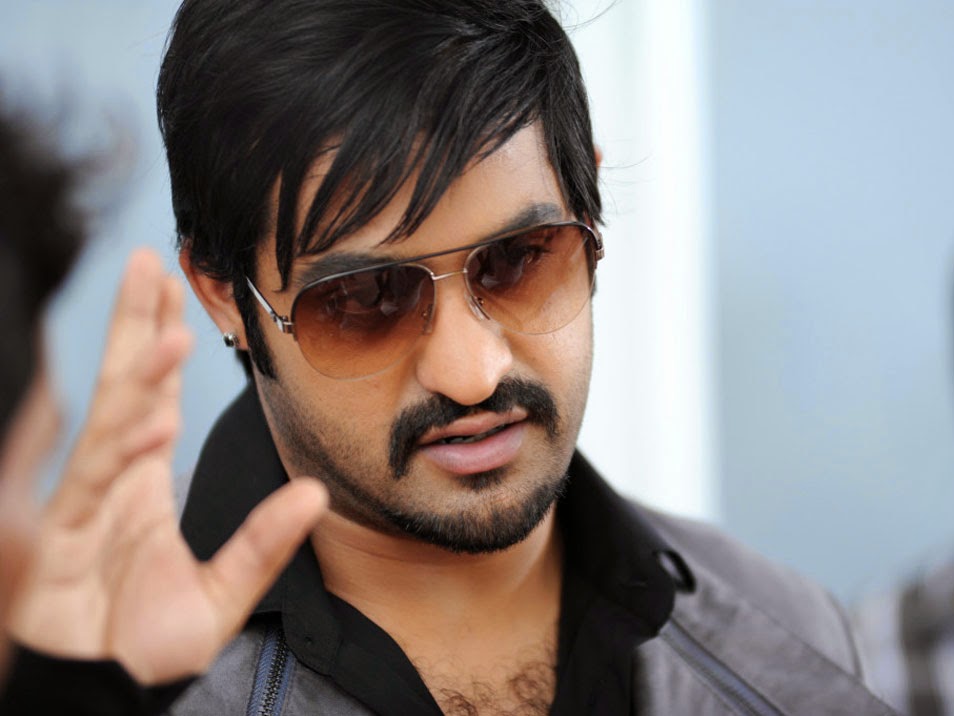
Today I am going to talk about one of the stars of the Telugu film industry, pictured above. He is Nandamuri Taraka Rama Rao Jr., otherwise known as Jr. NTR. He is a part of a great movie family (movie dynasties being quite common) headed by his namesake, N.T. Rama Rao. You might remember Jr. NTR from this video:


Yeah, that's him. Aside from being a good actor, he is one hell of a dancer. In fact, he is trained in Kuchipudi, a type of classical Indian dance from that region. So I guess you can say he's classically trained. Fans call him "the Young Tiger."

He tends to get cast in my favorite genre: the South Indian Action Film (tm). While his films are not always financially successful, they are almost always (in my eyes, anyway) entertaining. Here is a selection of four films by Jr. NTR that I watched recently.

Shakti (2011)

Shakti is the movie where the above video comes from. Describing the movie is a challenge in itself: it's basically a road movie that turns into a thriller that turns into a fantasy movie. The villains are people who act like ancient Egyptians and live in the Pyramids, who have lived there at least as early as... around 1984. Yes, in this movie, our villains lived (and apparently still live) in pyramids in the early eighties. Why they weren't spotted by any tourists or archaeologists is unknown.

Jr. NTR plays (at first, anyway) a tour guide with a number of secrets that are revealed one at a time. These revelations come so far out of left field that it hits harder than an M. Night twist. Here he is partnered with Ileana D'Cruz (I wonder where the name came from!) who he starred with in another film that I don't remember.

He also gets this badass introductory sequence on an elephant, which lasts like a minute and a half.
Shakti was not taken well by the critics because of its rather implausible story. While I agree that the story is a bit far fetched, I enjoyed the heck out of it, although the ending dragged the movie a bit more than I would have wanted.

Baadshah (2013)

Baadshah (Emperor) is probably Jr. NTR's best known film outside of India, and one of his top grossers. At first it seems to be about two completely different stories, a love story on one hand and a story about a gangster's rise to the top of the criminal underworld on the other.

The intro also features a gun firing diamonds.

As the plot twists play themselves out (though to be honest there actually is just one big twist in this film) the two storylines connect. Jr. NTR's Baadshah is larger than life, and true to formula he kicks butt with style and with bodies flying with no heed to gravity or even common sense. But it's fun as fun can be. His co-star in this film is Kajal Aggarwal, who we  may remember as the person who played Kavya in Singham. Her base was always South Indian cinema, and her pairings with Jr. NTR are often the most successful.

The soundtrack to the movie is quite impressive and has lots of good songs, notably the title song, "Baadshah," which we don't see until 1/4 into the movie. There's also a rather lengthy dance sequence near the end which is more or less a tribute to the original NTR and his movies.

Rabhasa (2014)

Rabhasa is probably my favorite out of all the movies I'll be talking about today. To put it in its simplest terms, Rabhasa is one man's quest to get married to his cousin at his mother's request. To tell the story would involve me explaining the movie comprehensively so as to spoil the entire thing. The magic of this film is the web of (well intentioned) lies and deceit that Jr. NTR's character weaves to get the girl. Everything seems to have plans within plans within plans, and even though this film is not as action packed as other Jr. NTR films, I really dug it. The connections between the characters are also quite convoluted, but in my case it was not enough to make it confusing.

Here Jr. NTR contends with Samantha Ruth Prabhu (heroine of the landmark Telugu film Eega) and Pranitha Subash in an extended role. The chemistry between the Young Tiger and Samantha is unique from his other pairings and I liked how their relationship in this movie evolved over time.

The intro sequence has NTR jump on top of a car, which would be more badass had it not been ripped off from Dabangg 2.
Near the end of the movie I still had absolutely no idea what was going to happen to our protagonists and the families they were involved in. I hadn't been that excited to see the conclusion of a movie in quite a while, so it was a genuine rush. The story wraps it up a little bit too quickly in the end, but is adequate enough to resolve most of the plot threads.

Ramayya Vasthavayya (2013)

And finally we have this film. It's more or less a film for Jr. NTR fans only as the plot is your standard South Indian action revenge plot with a huge twist in the middle. For regular movie goers there isn't a lot to keep attention. What makes it stand out, however is the number of good songs and some decent action.

While the first half plays out much like Rabhasa, there is a huge twist just before the intermission and everything goes to hell in a handbasket. The rest of the second half is mostly one huge flashback to try to connect everything into one package. The result is only somewhat successful.

There isn't really an intro sequence, but there is this costume thingy and a DDLJ reference shortly after.

Like in Rabhasa, Jr. NTR is paired with Samantha Ruth Prabhu in this one, although he is also paired up with Shruti Haasan, which in my humble opinion is the prettiest of Jr. NTR's co-stars so far. The antagonist is portrayed by P. Ravi Shankar, who was the villain in the Kannada remake of Singam, Kempe Gowda.

Again, the one thing I liked about the movie was the super catchy soundtrack, most notably "O Lailaa" which is kinda cute and stalky-ish at the same time thanks in part to the two main actors selling it like pancakes.

That's it for my roundup. You can probably find copies of these films on the net or online stores. Jr. NTR just had a movie come out, called Temper, reuniting him with Kajal Aggarwal, and reports say it was a blockbuster exceeding Baadshah;s box office take. I'm personally excited as frak.