rotban

Saturday, February 15, 2014

Road to the Oscars - Philomena

Philomena is a simply plotted film that works really well because of its simplicity. The titular character, portrayed by Dame Judi Dench, had a son when she was a young woman. She had the child out of wedlock, and  lived in a convent where her son was eventually put for adoption.

50 years later, with a family of her own, her thoughts drift back to that that time and the son she never saw again. She recruits the services of Martin Sixsmith (Steve Coogan) who slowly but surely forms a bond with her as the film goes on.

The film banks on the performances of Dench and Coogan, and their comedic timing is spot on. Judi Dench comes across as a loveable old lady who just wants to see her son again. Her drive to see her son is compounded by a sense of guilt from what she experienced long ago.

Steve Coogan's character slowly becomes a son figure for this lady and their interactions are quite entertaining. He even comes to defend her later on when he confronts the convent sisters who set up her son for adoption.

The movie takes a few liberties with the actual facts, but the identity of Philomena's son and the real life character of Martin Sixsmith (he really was writing something about Russian history) is on point. The film even ends with actual footage of the real guy in the credits.

In true British fashion the film ends with life continuing on as normal, but with people changed (either for better or worse.) It's not as glitzy as the other films contending for an Oscar, but it ends up there toe to toe with the best of them.

Wednesday, February 12, 2014

Road to the Oscars - Her


Some of the best science fiction stories are stories that expose the best and the worst of humanity through fantastic and futuristic lenses. In Spike Jonze’s latest film, Her, human relationships are the centerpiece. Remarkably, this film works really well, and is more revealing about ourselves than many films about love this year.

The world of Her is not unlike our own, and one that is all too plausible. It’s a near-future place where people are ever more reliant on technology. People are focused on their tablets and smartphones and headsets, relying on technology for many things in their daily lives.

Theodore Twombly (Joaquin Phoenix) is one of these people. He plays virtual games alone and talks to his computer about everything (even the weather). And yet he's not really that social a guy: he has a few friends, he's breaking up with his childhood sweetheart (Rooney Mara) and he awkwardly goes on a few dates and virtual meetups with people. Ironically, his job is to write letters as a proxy for couples in love.

This disconnect becomes a theme in the film where we see people losing connections with each other. Rather than using technology as a means to meet each other, people get together with the technology itself. Twombly encounters an interactive operating system with artificial intelligence (voiced by Scarlett Johannson) and falls in love with her. Later in the film we see that this is not a strange thing by the standards of this world: Twombly's friends, for the most part, accept this burgeoning relationship as completely normal. It's taken to extremes later on when an actual person acts as a proxy between man and program.

If it feels a bit unsettling, it's meant to be made that way. We're all social animals, but we're all left groping in the dark for answers. Relationships with others are a rocky path from start to finish; there is no guide to eternal happiness lying around in some book or program somewhere.

Her tells its story in warm fuzzy colors in pastel and brown, and a soundtrack by indie band Arcade Fire. The acting from all corners is superb and nuanced. Although there are some weird turns in the script (a date with Olivia Wilde comes to mind) overall the story is solid.

Her isn't just one of the best sci fi movies of the year, it's also one of the best movies of the year, period. But in the shadow of other movies competing for awards this year, it may end up lost in the crowd. Give it a go, it's a movie worth watching.

Monday, February 10, 2014

A look back at Sana Dati

When I last reviewed Sana Dati a few months ago, I had a rather low opinion on the concept of true love. To quote my old self:

Full Disclosure: I no longer believe in weddings. I no longer believe in true love. I no longer believe in starting a family or having kids or having any kind of meaningful romantic relationships with anyone. I guess I no longer believe in a lot of things.
Do note that I loved this film. So... yeah. Since then my thoughts on the above have changed a bit. That's probably one of the understatements of the year.  While I believe in love, I still think that love-at-first-sight whirlwind romances are overrated. Some of the best forms of love are the kind that you nurture over time.

I recently rewatched this film during a limited screening at Fully Booked (it's a crime that this film isn't distributed more widely) to see if my renewed perspective on love would change how I saw the film. The short version of what happened is: I still loved the film, but for different reasons. I still consider it one of the best films of last year.

So I feel I have to revisit the film's themes with this new perspective. My comments on the technical aspects of the film stay as they are; and some of the comments below WILL spoil you if you haven't watched the film.

"Sigurado Ka Ba?" (Are You Sure?)

Sana Dati begins with a quote from Voltaire: "Doubt is not a pleasant condition, but certainty is absurd." Indeed, certainty and its role in commitment is one of the movie's main themes. In the beginning and end scenes of the film, we hear the characters ask each other some variant of "Sigurado ka ba?" but in different contexts. At the beginning, Andrea asks Andrew if he's sure about getting a flower store for the both of them. He says yes, both in words and in print later on. Near the end, Robert tells Andrea in an impassioned, impromptu vow that he's never been more sure about her. And at the very last scene of the film, Robert asks Andrea if she is sure she loves him.

Think about these three instances. In the first instance Andrew is in the throes of a wild, passionate love - where he abandons everything to be with his beloved. He can't be more sure than he is now. In the second instance Robert loves Andrea, but his love stems from patience and something more measured albeit similar to Andrew's response to love (see below for more details.) In the last instance, the scene can be interpreted in different ways. Either Andrea has completely moved on and has accepted Robert's love, coming to love him, or she's lying, and she really isn't sure, but she'll try to live with this doubt and learn to love him anyway. Personally I believe in the second interpretation as it capitulates the essence of Voltaire's quote, and it matches my belief (stated above) that love can grow over time, slowly but surely, and can eventually be as strong as love that comes like lightning.

All three instances are forms of commitment, and none of these forms of commitment, of surety, are as valid as any other.
 
The Anti Rom Com

We're often exposed to the notion that true love conquers all in print, in film or in television. Most of the romantic comedies or dramas available for Filipino audiences fall along these lines. What's so refreshing about this film is that it challenges this notion, revealing its relative impotence.

Andrew's story reflects this love conquers all philosophy. Driven by the desire to be with the person who he loves, he abandons his life and family to be with her. This ends up more or less as we expect. Not even love can counteract common sense.


In the end, one can interpret the film to argue that such carefree philosophies are precarious ground. Many of us know from experience that love does not always flourish; many of us who have been rejected or who have left a relationship know that love, whether lost or never reciprocated, can die over time and fade away. A relationship is an arduous, rocky process. And it's a strange thing at first, living with a complete stranger for (presumably) the rest of your life, longer than your parents, your siblings, or anyone else. People have to get by their insecurities, their partner's flaws, and ultimately their own selfish ideas about love. It's all about understanding your partner and building from there.


The True Hero

During my first viewing of the film back in Cinemalaya 2013, I empathized with Andrea - a person who has just lost her love, and in a fit of abandon, decides to marry a person she "does not know." Her longing for her one true love hit me in a way back when I was in a similar situation, and the repercussions of her actions in the final scene of the film haunted me well after I saw the movie.

On closer inspection of the film's themes, I realized that I had neglected Robert's character in my viewing of the film. I had pegged this man to be the alpha male, the "victor" of this complicated love polygon that gets what he wants, when he wants.

I was completely wrong. This man is the unsung hero of the film.

Early on we see that Robert knows something is up. He's a politician, but we see he's more of a public servant during the scenes that establish his character. Upon rewatching the scenes, knowing what we know from the previous viewing we see that Robert's not really a bad guy. He never used his status or power to force Andrea to love him - remember that she came to him first after her little tryst with Andrew. When he senses that Andrea's having cold feet, he does not force the issue -  instead, he mulls over breaking off the wedding - denying himself the chance to be with his love, only because she still has lingering feelings for someone else.

His character comes to a head during the wedding vows scene, where he apologizes to Andrea but tells her that he's sure he loves her. The film frames a shot with Robert talking to Andrea and with Dennis (as a proxy to Andrew) behind her. In a way, he's talking to Andrea and Andrew at the same time. He apologizes because he knows about their love. He apologizes because his love for her will never be the same as the love they shared. But still, he loves her - and he is damn sure of it.

Robert's story in the context of this film eventually became my favorite part of the film. Try watching the film from his perspective and see what you can come up with.

Closing Thoughts

The impermanence of things (including love) is a topic that has been showcased in many films before this, but few have been made that deal with the topic with such subtlety. Sana Dati is a film with emotions bristling just below the surface, a metaphorical pot just about to boil over. This is helped by the superb acting, of course. Every scene you see is something going by normally but there's always something bubbling beneath the surface.

In the end, the most fun thing about watching films like these is talking about it afterwards and trying to process it with your friends. There are a lot of other concepts (like the idea of fate intervening for the characters, the concept of a marriage of convenience or a marriage for political or other cultural reasons, and so on) that I haven't touched upon. When I watch the movie another time (hopefully it comes out on DVD), I'll write some more about this remarkable film.

Sunday, February 09, 2014

Road to the Oscars - 12 Years a Slave

Slavery in the USA has always been a touchy subject, and the gamut of stories from this era of history has ranged from Django Unchained to Roots. But I'd make an argument that it's an important era of history, and one that people should be aware of..

12 Years a Slave is a film based on the account of one Solomon Northup, a free man who was sold as a slave after being duped by unscrupulous men. He then serves as a slave to different people, both (relatively) kind and not so kind. Most of the film centers on his experiences with the not so kind slave owner, portrayed in manic detail by Michael Fassbender. 

Solomon's ordeal is also a transformation; he loses his name, his identity and, towards the end of the film, his spirit. One scene where he partakes in a church hymn reflects his surrender to his status as a slave. The depiction of the treatment of slaves is brutal: these human beings are truly treated like property. They endure not only physical abuse but emotional abuse as well.

The slave owners try to justify their abuses through religion, but they are slaves of the times as much as the African Americans are. They are entrenched in a belief system that, despite being oppressive, has been a part of their lives since birth.Had they been born in today's world, would they have acted the same way?

Hopefully the film (and others that will hopefully follow it) makes us think why did we let these transgressions occur, and how to prevent oppression like this from happening again.

Sunday, January 19, 2014

Road to the Oscars - Gravity

With the 86th Academy Awards around the corner, let's take a look at some of the contenders for this year's ceremony, with the best in mainstream (and not so mainstream) film.

Hollywood doesn't get a lot of space stories grounded in reality or near reality. This year's film, Gravity, is a rare gem - a story set in space without a lot of science fiction elements. Sandra Bullock is Ryan Stone, a medical engineer on a routine space shuttle mission. At first, everything seems normal until an unforseen disaster turns the next hour and a half of her life into a desperate fight for survival.

In Gravity, space itself becomes a sort of sinister character. Despite its majesty, it is rightly depicted as a cold and dangerous place. Small pieces of debris act as armor piercing bullets. The lack of Oxygen makes every breath important (Sandra Bullock has to cut down on that hyperventilation IMO). Yet despite the incredible odds stacked against her, this is a story of how people respond to these odds and confront them either with indignation or resignation.

The special effects of this film are amazing. You wonder if they really did film scenes up in space where there is zero gravity (it was actually done by special rigs). While scientifically the film takes its liberties, it's all for the sake of the overall entertainment value - and there are some aspects of the film, like the depiction of fire in space, that are pretty much spot on. The camerawork is excellent and disorienting,. fully immersing us into the setting. It spins and tumbles and stays in place, close to our main characters but steadily in orbit.

Gravity is one of the best movies of the year, and one of the best directed too. If you have a chance, give it a watch.

Thursday, January 02, 2014

2014 Movie Wishes

It's a whole new year for cinema all around. 2013 was a good year for Philippine movies. A LOT of really good films were released this year, and the overall ratio of good to bad films was not really that bad. This years inclusion of three Filipino-oriented stories as entries for the Academy Awards' Best Foreign Film award tells us of the richness of our country and culture when it comes to storytelling.

For Filipino Cinema:
  • I wish for more movies with more creative freedom, and not with stories shackled by budget/producers/whatever. And I'm not talking only about independent cinema here.
  • I wish for mainstream films that do not pander or treat its audience like idiots; a film that respects its audience and challenges them
  • I wish for audiences to keep their heads out of their asses and realize that they deserve so much more than 2 hour advertisements and the cinematic equivalent of shit.
  • I wish for movie makers and audiences to realize that "films for kids" do not mean two hours of inane plotless stupidity. Children have imaginations, let films use them. My best moviegoing experiences as a kid let me use my imagination, why do I have to be served junk like this?
  • I wish for no politics in the process of filmmaking. It's art, no one should be allowed to interfere.
  • I wish for a true dialogue between filmmakers, critics and audiences on Filipino Cinema, and not one where one side acts all high and mighty ("you don't get what the film is about!"), incomprehensible ("Here's a guy sucking on an orange. It's a film.") or esoteric ("The primary protagonist ensconces his verite-sufferance from the ingenue. Such travesty of thought can only be expressed by the sycophant. Merde! (That's French by the way)")  compared to others.
  • I wish people would extend film festival screening dates, because I keep on missing them. :
For Films in General:
  • No more fucking blockbusters that exist for the sake of existing, or crappy superhero films that none of us care about.
  • That said however, I'd want more fun movies on screen (not necessarily movies that had a lot of explosions and stuff in them.)
  • NO MORE ORIGIN STORIES, 80's/90's TV ADAPTATIONS, SEQUELS OR REBOOTS.
  • More from-the-ground-up, good concept films.
  • Less executive meddling.
  • Character development that isn't forced, contrived, or somehow involves rape.
  • More kudos from audiences to the documentaries, because some docus are really worth it.
See you bastards at the movies.

MMFF: Girl Boy Bakla Tomboy

Time to review some mainstream fare.

Vice Ganda has been making waves in the Philippines recently as a certified audience grabber. This film, where he plays all the titular guy, girl, gay and tomboy siblings, is admittedly not bad at all.

It's held down by a bit of weirdly timed melodrama and the film could have finished a bit earlier, but I don't mind it ending where they should. The product placements are few and far between and not as intrusive as other fims out there, and the jokes vary from corny to genuinely funny. What I found marvelous was the way all four Vice Gandas are seamlessly combined in one shot, most impressively in one sequence where they play a little game of Trip to Jerusalem. The combination of editing, CGI and doubles really works, and you really will believe that there are four people there despite all of them being portrayed by the same actor.

Maricel Soriano remains an actress of immense talent, effortlessly transitioning from one emotion to another. Joey Marquez is a bit underused but still works well in the setting. The kids who play the adoptive siblings are adorable for the most part. As for that kid who had blackface? Well, let's just say we can't market this movie in a few places.

As for Vice himself, his portrayals are not bad, with the straight laced cool guy, the airheaded girl, the shy tomboy and the gay, who is probably the most normal out of the four.

I've held some sort of belief that mainstream MMFF movies are crap. With this film, I see it's not always the case, and there is still hope.

Friday, December 27, 2013

MMFF: Boy Golden

Boy Golden is a film that has to be seen to believed. Full of random events springing out of nowhere, it's full of camp and fun.

It's buoyed by a great cast, excellent lighting and production design, and you can tell Chito Rono played around a lot with the material. I recommend a watch to see what the fuss is all about.

Instead of a formal review, here's a bit of dialogue I (as Mr. Ho) and a friend (Marla D) had to say about this film. (note: most of it is in Tagalog, unfortunately.)


Thursday, December 26, 2013

2013 Roundup: Manga

I've read a lot of great manga this year, so I wanted to share with you guys a bit about them.

End of an Era

Of the "big three" shounen manga (One Piece, Naruto and Bleach), the latter two have entered their final arcs (although I expect Bleach to go on for a while, given its languid pace.) But that's not what I'm going to talk about here. Other really great manga finished their runs this year, and some are my very favorites:

I'm probably going to post something about Blade of the Immortal (JP: Mugen no Jyuunin) once the English language editions come out, probably later next year or in 2015. But the manga's Japanese run came to an end early this year, and some intrepid scanlators have posted the last three volumes somewhere in the internets.

Long story short, Blade of the Immortal is one of my favorite manga EVER. It tells the story of an immortal samurai, Manji, who is tasked with killing 1000 evil men in exchange for the opportunity to die. In the process, he helps a young girl, Rin, take revenge over the people who killed her parents. Of course, nothing is as simple as it seems.

The last three volumes are a frenzy of great fighting and resolves most of the hanging threads of the manga. I've collected this manga for more than ten years, and the plots and character interactions are so good, it's worth the often one year wait between volumes. Add that to Hiroaki Samura's wonderful (sometimes gruesomely brutal) pencil art and interesting characters, and we have a winner.

Another Seinen manga that ended its run recently is Gantz by Hiroya Oku. This one attracted me due to the insanely high character turnaround in the first few volumes, although one can argue the plot really takes off once a stable team is formed.

Gantz is an acquired taste, and I know a lot of people who don't like it because it basically is action, gore and boobs. (That's why I like it, ironically.)

Gantz really dropped off my radar when the final arc began to kick into gear. Upon picking up the series again, I see that the series ends in a kinda rushed manner, but at least there is some resolution. A few chapters where our Gantzers encounter some very high level beings serves as an infodump revealing all the secrets of the manga's plot. It's still a decent end but I'd want a little more out of it.
If it's closure you want, the ending of Deadman Wonderland delivers. For those not in the know, it's about this kid who gets thrown into this amusement park style prison with inmates who can use blood as a weapon. Lucky for the kid, he can use blood as a weapon too. 

Its finale is all about our protagonists (?) Shiro and Ganta (as we've known all along) and the relationship between the two. Of course all the lingering questions about the prison, Shiro's origin and the true nature of that disastrous earthquake that set all these events into motion are answered.

There's an epic battle here, although the true battle is an emotional one. I enjoyed the anime adaptation of this one, but it focuses more on the darker, bloodier early chapters of the manga. Although it doesn't get any lighter, Deadman Wonderland really sets in the shounen formula at the point in the manga where the anime ends. I'd have liked to see a season 2 of this manga, but we'll see.

 On the other hand, the anime adaptation of Soul Eater was really great. Good character designs, a complex world, and great animation. When the anime started to diverge from the manga, you can see the drop in quality.

The ending of Soul Eater is... a non-ending. Nothing really gets resolved. It's as if the anime ending at least gives a bit of closure. I'm not a big fan of the manga ending one bit but hey, that's how the cookie crumbles.

Of all the manga that ended this year, none have the same emotional heft as Inio Asano's masterpiece Oyasumi Punpun. A coming of age story about a guy who sees himself and his family as cartoon birds, it's one of those rare manga that manages to pack an emotional punch. (I may write up something about it once a good translation comes out.)

The last few volumes really had it in for poor Punpun, as the manga had turned darker than ever. Life really sucks for the poor guy, but that's how life goes sometimes. If you haven't read this manga before, I recommend it wholeheartedly. No work has ever conveyed the pain of growing up, or living as an adult, or falling in and out of love quite as well as this manga.

Interesting Choices

Other new (or relatively new) manga caught my attention this year. Some are good, some are just okay, but I'm entertained, so what do I care, right?

Chihayafuru was my favorite anime of 2013. It simply defies description. It's part romance manga, part sports manga, part slice of life. I loved every minute of it and I hope they make a lot more episodes.

Now, Chihayafuru the manga is more or less the same. How can you make a manga about a card game so freaking interesting? Read Chihayafuru and find out.


Like Chihayafuru, Helter Skelter is classified as Josei (catering to adult women) but it cannot be more different. Readers of this blog (all three of you) might be familiar with a review of a live action adaptation of this manga.

It's not very violent in the physical sense, but this one might be one of the more emotionally violent manga I've read this year.


Attack on Titan is one of the year's runaway hits. Granted, the manga may not have the best artwork in the world (I personally think it's horrible) but the plot is excellent and keeps the reader on his or her toes.

There are still a lot of questions unanswered, and I look forward to reading a bit more about it every month. If the art is too much of a problem, there's always the great anime adaptation.


Aku no Hana is a coming of age/slice of life story as well, but vastly different from anything out there. It's been described as a "tainted pure love story" and I think the description fits really well.

An anime adaptation that lasted 13 episodes has come out and has   polarized the fanbase. Some stand by it and laud it as a great series, others totally hate the adaptation for using rotoscoping and pacing the story too slowly. Personally I like the anime adaptation, especially how the animation team adapted the classroom scene, which IMO is one of the single greatest anime moments of the year.


It's surprising that Akira Hinamoto, the mangaka of Prison School, is also responsible for the fantastic Me and the Devil Blues.

That's not to knock of Prison School though. It's art is top notch, and an ecchi series like this, which is two boobs short of a hentai show, needs good art.

It's also good comedy, if you're into that kind of stuff.


Wolf Guy has werewolves and boobs.

There's also rape in there somewhere. Huh.


There are a lot of other one shots and horror shorts that I've either forgotten or haven't included on this list. So, what manga did you appreciate in 2013?

Wednesday, December 25, 2013

MMFF New Wave Feature Films: Island Dreams, Saka Saka


Five films are part of the MMFF's New Wave lineup. I managed to catch two of them over the last day, and the results are not bad.

Island Dreams takes place on an island resort (the name of the resort is never revealed, but the film was shot in Batangas). Zach (Alexis Petitprez), an American (with a vaguely French accent) that comes to the resort to find a place recommended by a mysterious girl. Meanwhile, Julie (Louise Delos Reyes) is a plucky girl hoping to make it big by joining a talent search in the city. To make the money to go there, she tries to moonlight as a tourist guide, even though she isn't accredited.

Romance movies rely heavily on the actors and the concept. Island Dreams is pretty much a by the numbers romance flick, and it gets pretty predictable after you get through half of it. The trailer pretty much gives away most of the story, so if you plan on watching this film (whenever it becomes available) don't watch the trailer.


As for the acting, both of the leads have chemistry, but are overall a bit spotty. Petitprez's accent is sometimes a bit hard to understand, and he flip flops from being deadpan and emotionless to being fun and wistful, and Delos Reyes sometimes crosses the line from being cute and perky to being loud and annoying. The broken English doesn't help, either, but is understandable.


When the chemistry works, however, it really works. The movie doesn't rely too much on "kilig" scenes and that's good. It instead makes us ponder the nature of the relationship of the two leads. I would also have liked to see what happened to Julie's character to make her resent the concept of true love that much (other than just mentioning that her ex cheated on her,) but sadly it wasn't emphasized too much in the film.

There are a few unbelievable scenes in the script, but I'll leave that to your judgement. Also, the film suffers from some weird sound editing choices. Some songs sound like they were just recorded too near a microphone; others sound like they were recorded too far from the mic.

Island Dreams ends up being a fairly entertaining romance film, but if you've seen one of these, you've seen them all. That said, it's still probably going to end up better than most of the films in the main category.

------

Saka Saka is about two brothers (Ejay Falcon and Joseph Marco) who end up being private assassins for a corrupt governor. At first, as children they immerse themselves in the killing life, but as time goes on, their viewpoints on killing change.

Saka Saka feels very low budget from the time it starts, and it shows. At some parts, notably near the start, the movie feels like a telenovela on film instead of a real film. During others, the production design is really good.

The movie tackles corruption in the government, but doesn't really delve into it that much. Much like On the Job, it treats corruption as a systemic sickness, integrated into our way of life. There are some really nice scenes (the one with the convoy is a particular favorite) which reminds me of a certain political event from the past five years, but there are some scenes that seem unnecessary (is the romantic montage really necessary?) The movie delves into violence and brutality, but the budget sometimes rears its ugly head in these scenes.

Throughout the movie there are some really nice action sequences, but sometimes the action feels like a blurry/mis-edited mess (especially when there's an exchange of punches). There are some action tropes lifted from the most inane Filipino action movies (goons can't shoot straight, etc). The climax of the movie is one big action scene with a run through rooftops. It's nice to see the action genre slowly being revived.

The two leads act their asses off, and to their credit their performances enhance the film. The guy who plays the mayor deserves a bit of praise as well.

It's a nice film with a lot of great concepts, but the execution leaves much to be desired.

p.s. Why does Baron Geisler have that darkening makeup (too much IMO) while his sons, who work in the sun all day like him, don't have darkening makeup? Was sunscreen somehow available to them in the interim?

Tuesday, December 24, 2013

MMFF New Wave Shorts (slightly nonsensical reviews)


The holiday season in the Philippines is home not only to an extended period of Christmas cheer, family time and celebration, but also to... I almost can't say it...

The Metro Manila Film Festival.

While in its heyday the festival produced some of the country's best films, lately the festival has been host to a variety of inane, creatively bankrupt movies, often following some formula or serving as a sequel, designed specifically to be watched then disposed of. In the realm of food, fast food won't even serve as an appropriate metaphor. Unless if the fast food execs shat and pissed directly into our open mouths.

This doesn't mean the MMFF guys aren't trying. Recently they opened up a New Wave section featuring some lesser known directors. There was actually some creative spark in these productions. They also opened up a short films and animation category which gave the chance to a number of aspiring filmmakers.

So here's what I think of the Shorts/Animation I saw. (WARNING: I may not make a lot of sense)

Ang Lalong ni Kulakog is about a master and his rooster. It's nice. Students made this? I'm actually quite impressed. It's a shame that this is the only short of the competition that I've managed to see.

Tagad is not listed in the official program. It's about a group of skateboarders living in Cebu. There are a lot of nice shots of these guys skateboarding, but mostly it's a documentary style thing. The people interviewed are mostly young males in their twenties, but there are some older guys too. It's a bit short, but what else is there to say? It's an OK film.

Hintayin Mo Sa Sequence 24 is like the epitome of a student film. It's emo and a bit heavy on the cliches.  There's a bit of pretension in there too. A lot of the fantasy sequences are either confusing or unnecessary. But hey, it's got heart, and there are a few good ideas in there, so I can forgive its flaws. Like the title said, wait for Sequence 24.

#NoFilter starts out pretty innocently, with a girl taking a lot of selfies and WHAT THE FUCK IS THAT!? NO NO NONONONONONONO AAAAAAAAAAAAAAAAAHHHHHHHHHHHHHHH AHHHHHHHHHHHHHHHH AHHHHHHHHHH AAAAAAAAAAAAAHHHHHHHHHHHH AHHHHHHHHHHHHHHHHHHHHHHH
DEATH WILL COME FOR US ALL DEATH WILL COME FOR US ALL DEATH WILL COME FOR US ALL DEATH WILL COME FOR US ALL DEATH WILL COME FOR US ALL DEATH WILL COME FOR US ALL DEATH WILL COME FOR US ALL googly eyes DEATH WILL COME FOR US ALL DEATH WILL COME FOR US ALL DEATH WILL COME FOR US ALL 
DEATH WILL COME FOR US ALL 

...oh. I guess there's some kind of message in there about how we should appreciate our true selves. Again, it has this student film feel to it.

Up next, a couple of feature films.


Sunday, December 22, 2013

Three Lions on My Cap

I’ve talked before about the Indian awesomeness that is Singham. But Singham is only one of three remakes of the original Tamil film, Singam, which was released in 2010. So for today’s post, I’m going to talk a bit about the original film and its two remakes. For the sake of clarity I’ll be referring to Singham as the Hindi remake, because of the name similarity with the original.

India has a lot of separate film industries based on geographic region. Bollywood, which most of the general population is familiar with, makes Hindi language films.  For example, Kollywood refers to the Tamil film industry. Tollywood, the Telugu film industry (which, output wise makes a lot more than Bollywood) and so on. Some actors are exclusive to only one film industry; others start making movies in one region and move on to Bollywood or to other regions.

Singam, the original, was so highly successful it was remade three times (and redubbed in other languages, which kinda raises the point of why would anyone remake a film you could just redub). Singham is the most popular version, and something that you all probably know through this post. In Kannada, it was remade into Kempe Gowda, and in West Bengal it was remade into Shotru. The Hindi remake seems to be the most different of the four films storywise; Kempe Gowda and Shotru are far more closer to the original, with some scenes almost a shot for shot remake of the original (which again raises that redub vs remake point.)

I thought it would be neat if I talked about the three films and their similarities, and see if any of the remakes shapes up to the original. Spoilers follow if you haven’t watched Singam, but I’ll try to make it as vague as possible.

Two of the films have an opening sequence before anything starts off; Singam starts with these lions made of bullets that crash into each other and be generally awesome. Kempe Gowda begins with a rather run of the mill title sequence. Shotru takes us into the middle of the action.


Singam: Lions made of bullets. India you crazy country you


Kempe Gowda: Meh title sequence. I think they even used Impact as the English font.

The Hindi remake opens with the main plot of Rakesh Kadam, the poor cop that was driven to suicide after being oppressed by Jaikant Shikre, an evil gangster/real estate developer. Singam and the other two remakes do not follow this plot, and begin with the main baddie being brought to the hospital in an ambulance. His minions flock to see if he’s still alive, but the whole thing is just a ploy to flush out a traitor in the ranks.

Our three villains are a variety of nastiness. Mayil Vaaganam, the antagonist of Singam, is played by Prakash Raj, who was the villain in the Hindi remake. Here he wears a mustache of evil, and while he’s affably evil in Singham, he’s far more cutthroat in the original, which I attribute to the mustache.
"Jai ho!"

In Kempe Gowda he’s called Armugam, and he looks a bit more goony. His introduction sequence also involves this sped up shot of people standing in a half constructed building. Because… I have no idea.

"Honey Boo Boo 4-evaaaaaar!"

In Shotru, his name is Arjun Sarkar, and he’s a bit more of the affably evil type. He has this awesome beard that probably contributes to his badassness. His blades are shorter, but look like giant combat knives.

"Fuck you, my beard is awesome!"

In any case, the reason he’s so hard to catch is that he’s got the police under his command, much like in Singham. Also, he does most of his nasty work within the confines of the law.

We now go to the introductory scene for our main character. In Singam and Kempe Gowda, a bunch of rowdies (some in drag) steal valuables from a temple. In Shotru, it’s just a bunch of assholes in animal masks robbing a bank.

If the masks didn't come off, it would be a whole movie in itself.

In Singam and Shotru, the convoy of thievery is blocked by a bunch of statues in a row (Singam has more statues, Shotru has just four, but two of them are made of gold.) Also for some reason, the statues move. Holy shit.
this statue moves. I shit you not.

Kempe Gowda instead has a BIKE OF DOOM blocking the way.
Just making sure you know that this is a POLICE bike. Instead of a non-police bike.

After a short scene, we see our eponymous policeman kicking ass. Suriya portrays him in Singam, and he’s the coolest of the three. He’s also the best dancer, as you will see shortly.
I love the battle aura effects they do in this film.

In Kempe Gowda, he’s portrayed by Sudeep. Overall he’s pretty unremarkable, but does an OK job.

In Shotru, he’s portrayed by Jeet. Of the three he has this nice guy look that I can’t place.
also, different mustache.

The next scene introduces something that was kinda downplayed by the Hindi remake: the comic foil. In Singam his name is Erimalai and he is IMO the funniest of the three:
he even has his own theme song. kinda.

Kempe Gowda has this guy, whose introductory scene defies all belief. (Seriously, it’s like one of the stupidest jokes ever)
One of the few facepalm worthy scenes of the franchise.

Shotru instead uses a scene also seen in the Hindi remake to introduce the comic foil:
if you think he's the guy on the left, you're an idiot.

All three films then use a football match (soccer for all those non American folk) to segue us into our first dance scene. Singam’s dance scene is really awesome, and is one of my favorite songs of all four films. It helps that Suriya is a good dancer. They also integrate Erimalai into the dance, which is pretty neat.
the guy on the right (Sanjay "stick out tongue" Raj - haha I made that up) is living the life.

Kempe Gowda has a nice song too, and they have this split screen thingy going for them…
...It's like watching three musical numbers at once!!

…and in Shotru, the main guy gives his trophy to the opposing team. Also, he’s so white compared to the rest of them. All three songs are an inspirational song singing about how awesome it is to be a nice guy and praising several gods.
seriously, he's like the whitest guy in the picture.

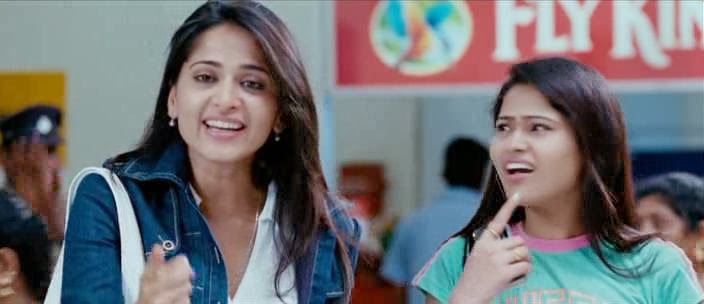
Singam and Shotru introduce our main female character. In Singam, she’s portrayed by Anushka Shetty, and her opening scene is her and her sister potentially committing a crime at the airport (!?) to showcase her carefree attitude:
I... can't think of a caption without being an asshole.

In Shotru, Nusrat Jahan plays her, and it takes place in a train station, but somehow makes less sense. I kind of like the Shotru version. It helps that she is pretty as well.
"I love One... Direction"

Kempe Gowda seems to eschew all this and move into the “girl scaring the villagers” scene to introduce her character. If you remember in Singham, Kavya dresses up in a ghost costume and scares the villagers (leading Singham to bitchslap her with prejudice -  to his credit he didn’t know it was a girl behind the costume). In Singam and the two remakes, the female lead wears a tiger costume instead. Given how fake the costume looks, (and given how IT’S WALKING ON TWO LEGS IN ALL THREE VERSIONS) it’s rather quite silly.
The Singam version has it all in blurs...
In Kempe Gowda, it's dark and people don't see all that well in the dark...

In Shotru, FUCK LOGIC

Regardless of the silliness, this is how all great romances begin. The romance proceeds much like Singham – but the circumstances behind our policeman and our girl getting hitched is a bit more complicated (and I personally found it hard to understand too.)
Between Shotru and Kempe Gowda, Shotru keeps in many of the jokes in the original while Kempe Gowda takes a bit more serious approach. There’s one skit with a goat that’s particularly funny.
(Singam) ... it's so ridiculous it's funny.
(Shotru) ...even in the remake.

There’s also one scene in the original that isn’t in the Hindi remake: the villain extorts money from a guy trying to make a house/school/building, blackmailing him by threatening to reveal he undervalued the property in exchange for a nominal fee. If he doesn’t comply, he’ll be falsely accused of rape AND may be imprisoned for what he did (Singam also adds 2 dead bodies in the mix.) 
 (Kempe Gowda) "I want these cookies FOR FREE!"

 (Singam) "I want two cookies!"

(Shotru) "FUCK COOKIES, LOOK AT MY AWESOME BEARD!"

This of course drives the poor guy to suicide. He types in a computer while he does this, addressing a different guy (his son in Singam and Kempe Gowda, a minister in Shotru). It also leads to poor capitalization.
(Shotru) MS WORD: the go to program for Indian movies

Looking at the films’ structure, Kempe Gowda rearranges a lot of the scenes from Singam and feels similar but different at the same time, if that makes any sense. A lot of the scenes from the Hindi remake and the original are in all versions. For example, there’s the scarf stealing thing at the movie theater. The Kempe Gowda version has particularly brutal car destroying, sign smashing action:


(that’s right, he threw a guy into a van SO HARD that the van TUMBLED. Henry Cavill, move over bitch)
SHORYUKEN!

the female protagonist filing fake police reports to catch the attention of the main guy, the confrontation between main guy and villain…
(Shotru ups the ante of this confrontation… with POLKA DOTS.)

…also the main guy moving into bad guy territory and getting harrassed. There’s a pier scene in the Hindi remake, Shotru and Kempe Gowda but in different contexts; Singam does it in a beach.
"I want a dance scene here, NOW!"

There’s also this cargo container scene in Singam, Shotru and Kempe Gowda: while in the first two the bad guys are hoisted up by a crane:


in Kempe Gowda a cargo container comes in to crush them:

Eventually our hero manages to tie the kidnapping activities to the villain after he tries to kidnap the female lead’s sister: something that’s seen in all four films.
 This is the Shotru version.
The bandages in the original version are weirdly placed.
There’s also a restaurant action scene that’s seen only in the original.
You know this isn't going to end well for some poor fucker.

The villain tries to ambush our hero in all three films by sending in one of his people to file a false report:

Shotru has the nicest office of all four films...

(Singam) You'll like the lady cop. She puts the smack down on this lady

Funnily enough, in Kempe Gowda, they “search” terms by typing them into Microsoft Word. Okay, maybe he was using it as some kind of notepad, which is pretty clever.
He was typing really fast so the typos are understandable. :p

In the original, the villain takes it personally and targets the love interest directly. In the original and in Shotru, they trap her inside a garage. Kempe Gowda traps her in a garage too, but only after a wild run through rooftops:
This lady runs FAST. Must be the cardio she does daily.

She manages to get away by lighting the petrol the baddies are pouring into the garage. I dunno how it worked but it did.
 (Kempe Gowda) SH-BANG!
(Shotru) smaller garage door, same explosion.

The villain then proceeds to shoot the love interest as she gets away. This understandably makes our hero really really pissed off. Shotru is the most unremarkable…
Shooting a gun just got more awesome with this fucking excellent beard-ah

Singam has the most bloody wound…
Indian Dracula has to be having a fit right now.

Kempe Gowda had this cool slow mo CGI bullet effect.
WHOA WHAT IS THAT MANJI DOING OVER THERE

Then, the final confrontation. There’s this big police operation and our villain is on the run. Singam has our hero drop kick his way to victory, but only after giving his enemy many chances to reform.


He also takes a hostage in all three versions. This one’s the Kempe Gowda version:

The end credits scenes are also different. In Singam and Kempe Gowda, our hero is given another assignment, setting up the possibility of a sequel (and Singam 2 did come out recently, - it has Nigerians and weapon smuggling and a dance scene on a boat – it’s an OK film.) In Shotru, our hero and female lead are just in the car talking together. No extra assignments are given.


So what did I think of the original and the remakes? Singham, the Hindi remake, is really good and stands on its own. Between Singam and the two other remakes, nothing really beats the original. It’s a fun masala film where you can see why people bothered to remake it so many times. Should I recommend seeing them all? Do you really want to see the same 2.5 hour movie three times? I’d recommend seeing Singam and the Hindi remake; leave the rest alone unless you want to see the story with your favorite actors of the region.